
Science
Researchers Use New Imaging Method to Advance Fusion Energy Studies

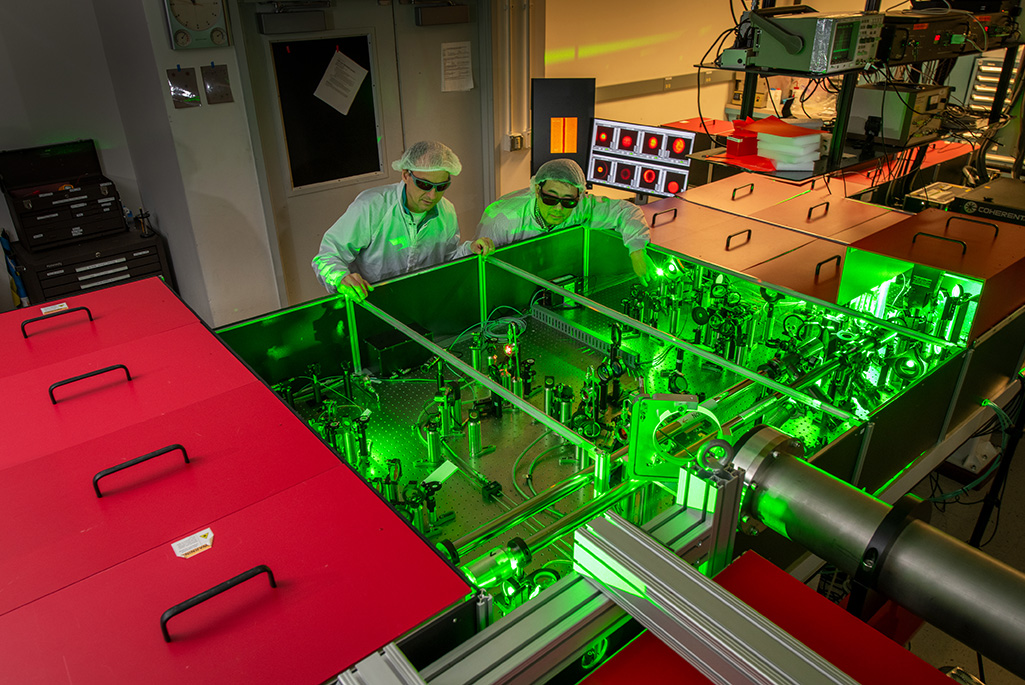
Researchers at the University of Michigan and the Lawrence Berkeley National Laboratory have made a significant breakthrough in fusion energy research by using a novel imaging technique that combines ultrafast X-rays and electrons. This innovative approach allowed them to capture a detailed view of a shockwave moving through water, revealing critical insights that previous experiments could not provide. The findings, published on December 16, 2025, in the journal Nature Communications, could enhance understanding of the microphysics involved in fusion reactions.
Uncovering New Details of Shockwave Dynamics
The research team discovered an unexpected layer of water vapor that contributed to the symmetry of the shockwave, a characteristic similar to those observed in certain targets used for inertial confinement fusion (ICF). By employing a technique known as “multi-messenger” imaging, the researchers utilized both X-ray and electron beam technologies to observe the dynamics of the shockwave in unprecedented detail.
Fusion, the process that powers the sun, involves merging hydrogen atoms to form helium, releasing energy in the process. As researchers strive to replicate this phenomenon on Earth, understanding the complexities at the smallest scales during fusion reactions becomes essential. In ICF, for instance, lasers bombard a fuel-filled capsule to generate shockwaves that heat and compress the target, initiating fusion.
While scientists have long grappled with the intricacies of these interactions, the team at Berkeley Lab’s BELLA Center successfully captured the shockwave’s evolution through a jet of water, significantly advancing the field of fusion energy research.
Innovative Techniques and Collaborative Efforts
The project was spearheaded by Mario Balcazar, who, while a graduate student, proposed the experiment at the BELLA Center. The concept emerged in 2019, aiming to leverage the unique properties of X-rays generated by intense lasers to create a “movie” of plasma dynamics. “There’s a lot of excitement surrounding recent breakthroughs in laser-driven fusion,” said Alec Thomas, Balcazar’s advisor. “Making further progress requires accurate diagnostics to capture the dynamics of hot plasma.”
To execute the experiment, the researchers developed a flowing jet of water as a target, which required extensive engineering to maintain its integrity during the vacuum conditions of the experiment. This setup allowed for rapid laser firing, unlike traditional solid targets that necessitate replacement after each use.
The experiment utilized a laser-plasma accelerator (LPA) that generates ultrafast X-rays and high-energy electron beams. By synchronizing the delivery of a shockwave to the water, the team was able to create a high-speed movie showcasing the shockwave’s progression. The initial phases of the study relied solely on X-ray imaging, revealing surprising discrepancies between experimental results and simulations.
In response to these inconsistencies, follow-up experiments conducted in 2020 and 2023 integrated an electron probe, enabling the dual-probe perspective that unveiled the critical vapor layer surrounding the water jet. This “vapor-assisted” symmetry mirrors conditions in some fusion targets, offering a new avenue for studying the impacts of symmetry in fusion-relevant scenarios.
Hai-En Tsai, a research scientist in the Accelerator Technology & Applied Physics (ATAP) Division at Berkeley Lab, noted, “We watched the interaction in picosecond steps, frame by frame, with micrometer imaging precision. These results can actually help verify the simulation models used for ICF.”
The research team included experts from six institutions, emphasizing the collaborative nature of the work. The project was funded by the U.S. Department of Energy’s Office of Fusion Energy Sciences via the LaserNetUS program, which provides access to high-power laser facilities across the United States.
As researchers continue to refine laser-plasma technology, the insights gained from this experiment could pave the way for future advancements in fusion energy, potentially offering a sustainable and abundant power source for the future.

Robinhood Stock Surges 2.5% in Early Trading on March 17

Israel Intensifies Strikes as Global Energy Crisis Looms

CALV Offers Class on Communication Skills for Real Estate Professionals

Historic Bideford Pub Reopens as The Patch Wine Bar & Kitchen

Oscar Night Celebrations: Winners, Guests, and Exclusive After-Parties

Samsung Galaxy Watch 9 Set for Larger Battery Boost, Report Reveals

Kibble vs. Fresh Dog Food: What’s Best for Your Dog’s Health?

Acclaimed San Francisco Pizzeria Del Popolo to Close in May

‘Invincible’ Season 4 Launches on Prime Video with Epic Action

ALMA Discovers Companion Orbiting Giant Red Star π 1 Gruis

Doctoral Candidate Trivanni Yadav Advances Battery Research at UTulsa

Global Air Forces Ranked by Annual Defense Budgets in 2025

Rev. Bry Shields to Retire as McGill-Toolen President in 2026

Mass Production of F-35 Fighter Jet Drives Down Costs

Tucson Celebrates Life and Remembrance at 36th Annual All Souls Procession

Gold Investment Surge: Top Mutual Funds and ETF Alternatives

DirecTV to Launch AI-Driven Ads with User Likenesses in 2026

Paul Giamatti Reveals Villainous Role in Star Trek: Starfleet Academy
-
 Science9 months ago
ALMA Discovers Companion Orbiting Giant Red Star π 1 Gruis
-
 Science8 months ago
Doctoral Candidate Trivanni Yadav Advances Battery Research at UTulsa
-
 World10 months ago
Global Air Forces Ranked by Annual Defense Budgets in 2025
-
 Lifestyle10 months ago
Rev. Bry Shields to Retire as McGill-Toolen President in 2026
-
 World10 months ago
Mass Production of F-35 Fighter Jet Drives Down Costs
-
 Lifestyle9 months ago
Tucson Celebrates Life and Remembrance at 36th Annual All Souls Procession
-
 Business10 months ago
Gold Investment Surge: Top Mutual Funds and ETF Alternatives
-
 Top Stories10 months ago
DirecTV to Launch AI-Driven Ads with User Likenesses in 2026
-
 Entertainment10 months ago
Paul Giamatti Reveals Villainous Role in Star Trek: Starfleet Academy
-

 Lifestyle8 months ago
Maumee’s Shop With a Hero Event Delivers Joy to Local Children
-

 Top Stories10 months ago
New ‘Star Trek: Voyager’ Game Demo Released, Players Test Limits
-

 Lifestyle8 months ago
Cape May Shines as New Jersey’s Only Entry on Beach Town List