
Science
Scientists Investigate Unusual Behavior of Interstellar Object 3I/ATLAS

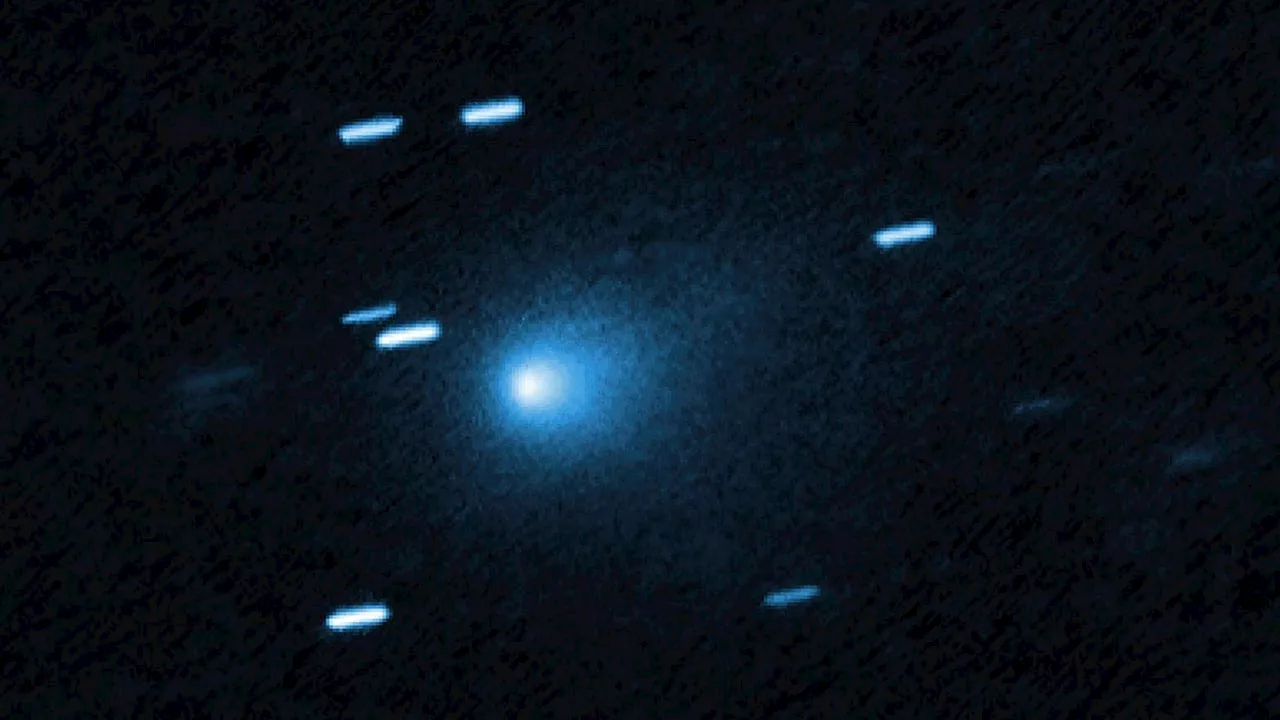
Scientists are investigating the curious behavior of interstellar object 3I/ATLAS, which has exhibited unexpected characteristics following its perihelion, or closest approach to the Sun, on October 29, 2023. This object, which came within 203 million kilometers of the Sun, has shown signs of non-gravitational acceleration and a notable lack of a cometary tail, raising questions about its composition and origin.
Dr. Avi Loeb, a theoretical physicist at Harvard University, reported that 3I/ATLAS has become significantly bluer than the Sun, which is atypical for comets. The absence of a tail, typically expected as such objects approach the Sun, has intrigued researchers. New observations reveal a blob of light instead of the anticipated cometary features, prompting further inquiry into whether this object is a natural formation or something more complex.
The peculiar nature of 3I/ATLAS has led to speculation regarding its potential connection to the famous ‘Wow’ signal, a mysterious radio signal detected in 1977. “It came from the same direction as the ‘Wow’ signal, and the question is whether they are related,” Dr. Loeb stated. “There are lots of anomalies that should make us curious.”
While some scientists are exploring the idea that 3I/ATLAS could be a technological object, Dr. Ken Gayley, an astronomy professor at the University of Iowa, emphasizes the importance of maintaining a natural origin hypothesis. “We would always start off with the assumption that these are natural objects,” he explained. “If there is strong evidence that they are not, then we might be led to another direction. For now, there’s still plenty of evidence that they are potentially just completely natural objects.”
As 3I/ATLAS approaches its closest point to Earth on December 19, 2023, scientists are eager to gather more data. This event presents an opportunity to gain insights into the conditions of other star systems and their formation processes. “That’s six days before Christmas,” Dr. Loeb remarked, humorously hoping for a safe observation period. “The last thing we want is for it to send a probe to planets like Earth.”
NASA notes that comets are typically named after their discoverers, in this case, the team behind the Asteroid Terrestrial-impact Last Alert System survey telescope located in Rio Hurtado, Chile. The letter “I” represents “interstellar,” indicating that this object originated outside our solar system. 3I/ATLAS is the third known interstellar object, following 1I/Oumuamua in 2017 and 2I/Borisov in 2019.
The scientific community remains vigilant as they continue to monitor 3I/ATLAS and its behavior, hoping to unlock the secrets of this intriguing interstellar visitor.

Robinhood Stock Surges 2.5% in Early Trading on March 17

Israel Intensifies Strikes as Global Energy Crisis Looms

CALV Offers Class on Communication Skills for Real Estate Professionals

Historic Bideford Pub Reopens as The Patch Wine Bar & Kitchen

Oscar Night Celebrations: Winners, Guests, and Exclusive After-Parties

Samsung Galaxy Watch 9 Set for Larger Battery Boost, Report Reveals

Kibble vs. Fresh Dog Food: What’s Best for Your Dog’s Health?

Acclaimed San Francisco Pizzeria Del Popolo to Close in May

‘Invincible’ Season 4 Launches on Prime Video with Epic Action

ALMA Discovers Companion Orbiting Giant Red Star π 1 Gruis

Doctoral Candidate Trivanni Yadav Advances Battery Research at UTulsa

Global Air Forces Ranked by Annual Defense Budgets in 2025

Rev. Bry Shields to Retire as McGill-Toolen President in 2026

Mass Production of F-35 Fighter Jet Drives Down Costs

Tucson Celebrates Life and Remembrance at 36th Annual All Souls Procession

Gold Investment Surge: Top Mutual Funds and ETF Alternatives

DirecTV to Launch AI-Driven Ads with User Likenesses in 2026

Paul Giamatti Reveals Villainous Role in Star Trek: Starfleet Academy
-
 Science9 months ago
ALMA Discovers Companion Orbiting Giant Red Star π 1 Gruis
-
 Science8 months ago
Doctoral Candidate Trivanni Yadav Advances Battery Research at UTulsa
-
 World10 months ago
Global Air Forces Ranked by Annual Defense Budgets in 2025
-
 Lifestyle9 months ago
Rev. Bry Shields to Retire as McGill-Toolen President in 2026
-
 World10 months ago
Mass Production of F-35 Fighter Jet Drives Down Costs
-
 Lifestyle9 months ago
Tucson Celebrates Life and Remembrance at 36th Annual All Souls Procession
-
 Business10 months ago
Gold Investment Surge: Top Mutual Funds and ETF Alternatives
-
 Top Stories10 months ago
DirecTV to Launch AI-Driven Ads with User Likenesses in 2026
-
 Entertainment10 months ago
Paul Giamatti Reveals Villainous Role in Star Trek: Starfleet Academy
-

 Top Stories10 months ago
New ‘Star Trek: Voyager’ Game Demo Released, Players Test Limits
-

 Lifestyle8 months ago
Maumee’s Shop With a Hero Event Delivers Joy to Local Children
-

 Lifestyle7 months ago
Cape May Shines as New Jersey’s Only Entry on Beach Town List