
Science
Scientists Slash CO2 Emissions in Fuel Production Breakthrough

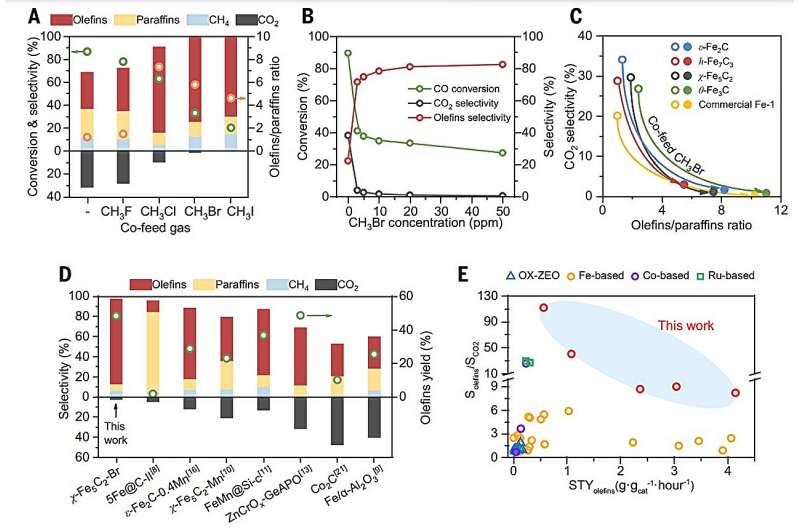
Scientists have achieved a significant breakthrough in reducing carbon dioxide emissions during the production of liquid fuels from synthesis gas (syngas). In a study published on November 4, 2025, in the journal Science, a research team from China reported that they managed to cut down CO2 production by over 99% during the conversion of crude oil products into fuels using iron catalysts.
The process under investigation, known as Fischer–Tropsch synthesis (FTS), is critically important in the petrochemical industry. It converts syngas, a mixture of carbon monoxide (CO) and hydrogen (H2), into liquid hydrocarbons. Traditionally, the process has been associated with high CO2 emissions, with selectivity rates ranging from 18% to 35%. This new method, however, demonstrates a dramatic reduction in emissions to nearly zero.
Innovative Use of Bromomethane
The key to this innovation lies in the addition of trace amounts of bromomethane (CH3Br) to the syngas feed. This halogen-containing compound significantly alters the catalytic reactions. The introduction of bromomethane resulted in an impressive increase in olefin production, with selectivity rising to 85% of carbon-containing products. Notably, the olefin-to-paraffin ratio improved to 13:1, a substantial increase from the previous ratio of 1.3:1 with unmodified catalysts.
The research team discovered that by co-feeding bromomethane, surface-bound bromine entities formed on the catalyst. These entities blocked two undesired reactions—the water-gas shift and Boudouard reactions—that typically produce CO2 and water as byproducts. This modification allowed olefins to escape the catalyst surface more readily, preventing their conversion into less valuable products.
Long-Term Stability and Future Implications
The modified iron catalyst exhibited remarkable stability, operating effectively for over 450 hours. The researchers emphasized that this practical strategy is compatible with a wide range of iron-based FTS catalysts, including commercially available formulations.
As the world continues to seek greener energy technologies, fossil fuels still represent over 80% of global energy consumption. Thus, enhancing the efficiency and environmental sustainability of processes like FTS is essential. The findings from this study may bridge the gap between fossil fuel chemistry and climate sustainability, paving the way for a more eco-friendly future.
This research represents a promising step forward in addressing the environmental challenges associated with fossil fuel use. By facilitating carbon-neutral conversions of coal and syngas, scientists are moving closer to achieving a balance between energy needs and climate considerations.
The study, led by Yi Cai and his team, emphasizes the importance of innovative approaches in tackling pressing global issues. As they continue to refine these techniques, the implications for the petrochemical industry and beyond could be profound, leading to a cleaner and more sustainable energy landscape.

Robinhood Stock Surges 2.5% in Early Trading on March 17

Israel Intensifies Strikes as Global Energy Crisis Looms

CALV Offers Class on Communication Skills for Real Estate Professionals

Historic Bideford Pub Reopens as The Patch Wine Bar & Kitchen

Oscar Night Celebrations: Winners, Guests, and Exclusive After-Parties

Samsung Galaxy Watch 9 Set for Larger Battery Boost, Report Reveals

Kibble vs. Fresh Dog Food: What’s Best for Your Dog’s Health?

Acclaimed San Francisco Pizzeria Del Popolo to Close in May

‘Invincible’ Season 4 Launches on Prime Video with Epic Action

ALMA Discovers Companion Orbiting Giant Red Star π 1 Gruis

Doctoral Candidate Trivanni Yadav Advances Battery Research at UTulsa

Global Air Forces Ranked by Annual Defense Budgets in 2025

Rev. Bry Shields to Retire as McGill-Toolen President in 2026

Mass Production of F-35 Fighter Jet Drives Down Costs

Tucson Celebrates Life and Remembrance at 36th Annual All Souls Procession

Gold Investment Surge: Top Mutual Funds and ETF Alternatives

DirecTV to Launch AI-Driven Ads with User Likenesses in 2026

Paul Giamatti Reveals Villainous Role in Star Trek: Starfleet Academy
-
 Science9 months ago
ALMA Discovers Companion Orbiting Giant Red Star π 1 Gruis
-
 Science8 months ago
Doctoral Candidate Trivanni Yadav Advances Battery Research at UTulsa
-
 World10 months ago
Global Air Forces Ranked by Annual Defense Budgets in 2025
-
 Lifestyle9 months ago
Rev. Bry Shields to Retire as McGill-Toolen President in 2026
-
 World10 months ago
Mass Production of F-35 Fighter Jet Drives Down Costs
-
 Lifestyle9 months ago
Tucson Celebrates Life and Remembrance at 36th Annual All Souls Procession
-
 Business10 months ago
Gold Investment Surge: Top Mutual Funds and ETF Alternatives
-
 Top Stories10 months ago
DirecTV to Launch AI-Driven Ads with User Likenesses in 2026
-
 Entertainment10 months ago
Paul Giamatti Reveals Villainous Role in Star Trek: Starfleet Academy
-

 Top Stories10 months ago
New ‘Star Trek: Voyager’ Game Demo Released, Players Test Limits
-

 Lifestyle8 months ago
Maumee’s Shop With a Hero Event Delivers Joy to Local Children
-

 Lifestyle7 months ago
Cape May Shines as New Jersey’s Only Entry on Beach Town List