
Science
Study Reveals Cosmic Rays May Foster Earth-Like Planets

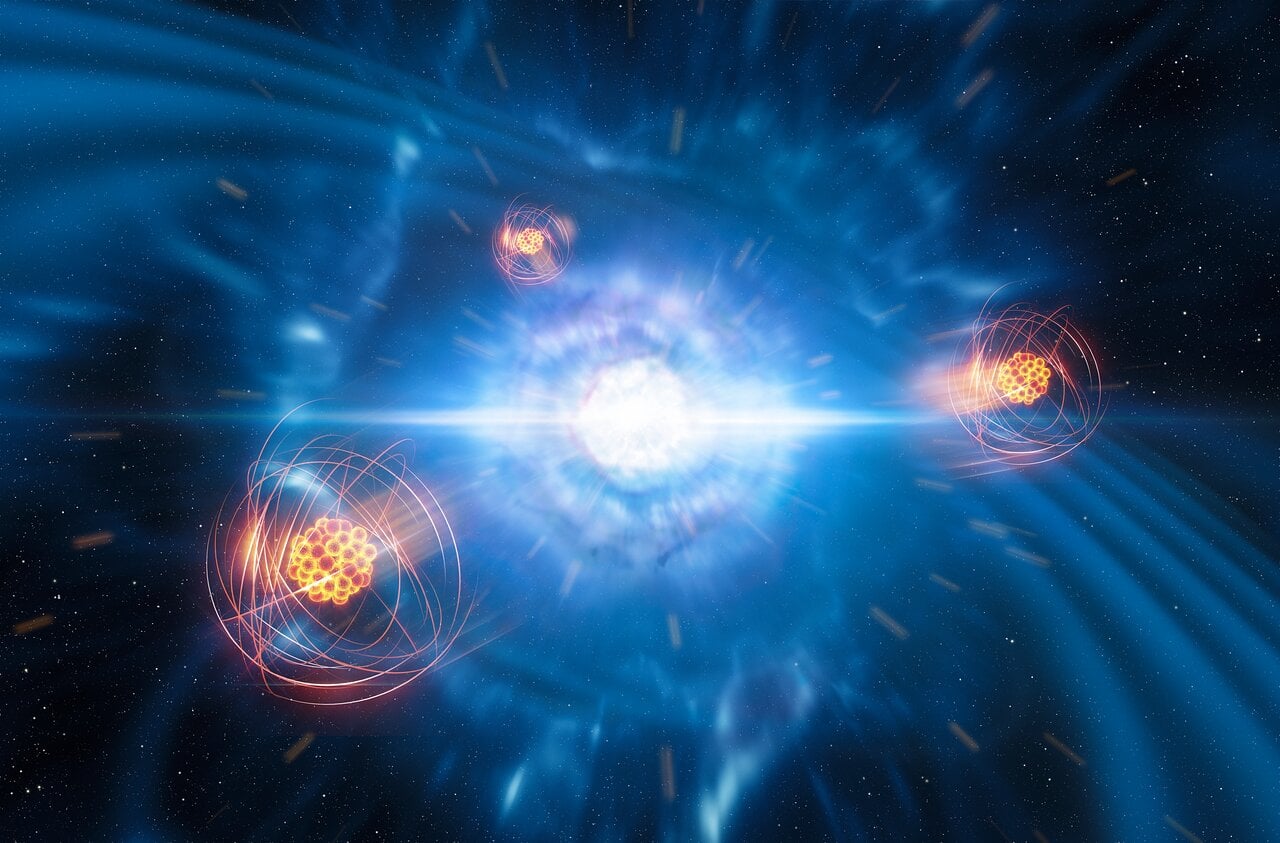
New research suggests that the formation of Earth-like planets may be more common than previously thought, thanks to the influence of cosmic rays from distant supernovae. The study, conducted by a team led by Ryo Sawada and published in the journal Science Advances, explores how these cosmic phenomena could provide the necessary conditions for the development of terrestrial worlds similar to our own.
Creating an Earth-like planet involves a delicate balance of factors. A planet must possess sufficient mass to retain an atmosphere and generate a protective magnetic field, yet not so much that it retains lighter elements like hydrogen and helium. Additionally, it needs to orbit at the right distance from its star to maintain liquid water, while also requiring an abundance of short-lived radioisotopes (SLRs). These isotopes, which have half-lives of less than five million years, contribute to warming the early solar system, thus preventing planets from accumulating excessive water.
The presence of SLRs, such as aluminum-26, has been confirmed through meteorite analysis. When aluminum-26 decays, it transforms into magnesium-26, allowing scientists to infer the earlier existence of radioactive aluminum in our solar system. Similar evidence exists for other isotopes, including titanium-44.
While this connection supports the idea that SLRs are crucial for the formation of Earth-like planets, there is a significant challenge to this concept. SLRs are primarily produced in supernovae, and the intense shockwaves from a nearby supernova could disrupt the protoplanetary disk of a developing star, potentially hindering the formation of planets. This raises the question of whether the conditions that allowed our solar system to develop might be exceedingly rare.
The latest study provides a new perspective on this issue. It posits that instead of being adversely affected by a nearby supernova, our early solar system may have benefited from being bathed in cosmic rays emitted by a more distant supernova. The researchers propose that if at least one supernova occurred within a distance of one parsec—a unit of measurement equivalent to approximately 3.26 light-years—it could have showered the solar system with sufficient cosmic rays to generate the necessary levels of radioactive isotopes found in meteorites.
Given that sun-like stars often form in clusters, the likelihood of experiencing such a supernova is relatively high. This finding indicates that the conditions suitable for the emergence of terrestrial planets like Earth may not be as exceptional as once thought.
Moreover, the study highlights that supernovae play a pivotal role in enriching the galaxy with elements such as aluminum-26. The existing levels of this isotope in the Milky Way provide insight into the frequency of supernova events over cosmic time, further supporting the plausibility of their role in planet formation.
In conclusion, the research by Ryo Sawada and colleagues presents a compelling argument for the potential abundance of Earth-like planets in the universe. By suggesting that cosmic rays from distant supernovae could create the essential conditions for these planets, the study opens new avenues for understanding the processes that lead to the formation of worlds capable of supporting life.

Robinhood Stock Surges 2.5% in Early Trading on March 17

Israel Intensifies Strikes as Global Energy Crisis Looms

CALV Offers Class on Communication Skills for Real Estate Professionals

Historic Bideford Pub Reopens as The Patch Wine Bar & Kitchen

Oscar Night Celebrations: Winners, Guests, and Exclusive After-Parties

Samsung Galaxy Watch 9 Set for Larger Battery Boost, Report Reveals

Kibble vs. Fresh Dog Food: What’s Best for Your Dog’s Health?

Acclaimed San Francisco Pizzeria Del Popolo to Close in May

‘Invincible’ Season 4 Launches on Prime Video with Epic Action

ALMA Discovers Companion Orbiting Giant Red Star π 1 Gruis

Doctoral Candidate Trivanni Yadav Advances Battery Research at UTulsa

Global Air Forces Ranked by Annual Defense Budgets in 2025

Rev. Bry Shields to Retire as McGill-Toolen President in 2026

Mass Production of F-35 Fighter Jet Drives Down Costs

Tucson Celebrates Life and Remembrance at 36th Annual All Souls Procession

Gold Investment Surge: Top Mutual Funds and ETF Alternatives

DirecTV to Launch AI-Driven Ads with User Likenesses in 2026

Paul Giamatti Reveals Villainous Role in Star Trek: Starfleet Academy
-
 Science9 months ago
ALMA Discovers Companion Orbiting Giant Red Star π 1 Gruis
-
 Science8 months ago
Doctoral Candidate Trivanni Yadav Advances Battery Research at UTulsa
-
 World10 months ago
Global Air Forces Ranked by Annual Defense Budgets in 2025
-
 Lifestyle10 months ago
Rev. Bry Shields to Retire as McGill-Toolen President in 2026
-
 World10 months ago
Mass Production of F-35 Fighter Jet Drives Down Costs
-
 Lifestyle9 months ago
Tucson Celebrates Life and Remembrance at 36th Annual All Souls Procession
-
 Business10 months ago
Gold Investment Surge: Top Mutual Funds and ETF Alternatives
-
 Top Stories10 months ago
DirecTV to Launch AI-Driven Ads with User Likenesses in 2026
-
 Entertainment10 months ago
Paul Giamatti Reveals Villainous Role in Star Trek: Starfleet Academy
-

 Lifestyle8 months ago
Maumee’s Shop With a Hero Event Delivers Joy to Local Children
-

 Top Stories10 months ago
New ‘Star Trek: Voyager’ Game Demo Released, Players Test Limits
-

 Lifestyle8 months ago
Cape May Shines as New Jersey’s Only Entry on Beach Town List