
Sports
Legendary Coach Lou Holtz Remembered for Impact at William & Mary

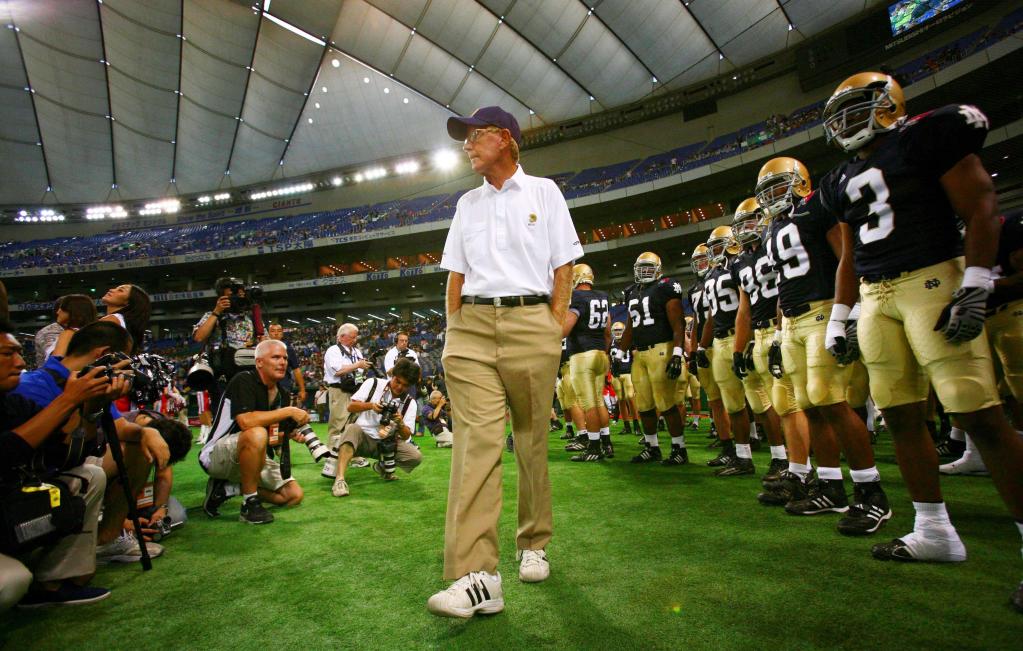
Lou Holtz, the esteemed football coach who left an indelible mark at the College of William & Mary, passed away on Wednesday at the age of 89. His storied career included two tenures at William & Mary, where he initially served as an assistant coach from 1961 to 1963 before returning as head coach in 1969. Holtz’s contributions to the team and the university have continued to resonate with players and colleagues long after his departure.
During his first stint, Holtz worked under head coach Milt Drewer and quickly made a name for himself in the coaching ranks. He returned to lead the program as head coach in 1969, where he faced the challenge of rebuilding a team that had seen recent turmoil. Over his three years at William & Mary, Holtz achieved a Southern Conference record of 9-4, ultimately finishing with a total record of 13-20. His tenure paved the way for future success, including a national title at Notre Dame in 1988.
In a 1989 interview with former Daily Press sports writer Bob Moskowitz, Holtz reflected on his time at William & Mary, stating, “If it hadn’t been for William & Mary, I wouldn’t be at Notre Dame today.” This sentiment highlights the profound impact the university had on his career and life.
Jimmye Laycock, a player under Holtz in 1969-70 and a long-serving head coach at William & Mary, spoke fondly of Holtz’s influence. “Lou always had a special place in his heart for William & Mary,” Laycock explained. He described Holtz as a demanding coach with a remarkable ability to motivate his players. “He was a ball of fire,” Laycock added, emphasizing the transformative experience Holtz provided to his players.
Holtz’s legacy was further cemented in March 2020 when he was inducted into the William & Mary Athletics Hall of Fame. During the ceremony, he expressed gratitude for the recognition, emphasizing the shared values between William & Mary and Notre Dame. “Both had the same caliber of athletes in intelligence, character, values, and willingness to work,” he stated, acknowledging the role the university played in shaping his coaching philosophy.
The impact Holtz had on his players extended beyond the football field. Joseph W. “Joe” Montgomery, a center on Holtz’s second team, described his experience as “transformative.” He recalled, “Going to play at William & Mary was the best decision of my life.” Montgomery credited Holtz with recognizing and nurturing his potential, saying, “He knew what your fears were and gave you the strength to handle them.”
Former players, including Jim Cavanaugh, a wide receiver who later enjoyed a successful coaching career, reflected on the challenges of Holtz’s first year as head coach. Cavanaugh noted that the transition was difficult, as the team was undergoing significant changes. “We felt like a class of freshmen, getting to know everything new in a short time,” he recalled.
As Holtz’s coaching career progressed, he faced a pivotal moment when he was approached by N.C. State following his tenure at William & Mary. He initially turned down their advances, stating he wanted to focus on his team and the season ahead. Ultimately, he accepted the position after the conclusion of the 1971 season, a decision that he would later reflect on with mixed emotions.
Barry Beers, who played offensive guard for Holtz, characterized him as “determined” and “aggressive in a good way.” Beers emphasized Holtz’s commitment to excellence, recalling that he “demanded the best of us and wouldn’t take any excuses.” He expressed gratitude for receiving a football scholarship that allowed him to attend William & Mary, saying, “I could never have afforded to come to William & Mary without it.”
In a poignant moment during his induction, Holtz reminisced about the strong bonds formed during his time at William & Mary. He recalled a gesture from the Quarterback Club, where members gifted him a new car, a testament to the lasting relationships he built over the years. “I told them I couldn’t take it because I was leaving,” Holtz remembered, illustrating the strong ties he maintained with the community.
William & Mary President Katherine Rowe encapsulated Holtz’s influence during the induction ceremony, stating that he “made a permanent impact on W&M’s football tradition and the university as a whole.” His legacy continues to inspire current and future generations of student-athletes, reminding them of the values of hard work, commitment, and excellence that he instilled during his time on campus.
As the sports community mourns the loss of Lou Holtz, his contributions to William & Mary and the broader football landscape will be remembered. His story is not just one of victories on the field but also of the profound personal connections he fostered, shaping the lives of those who had the privilege to play under his guidance.

Robinhood Stock Surges 2.5% in Early Trading on March 17

Israel Intensifies Strikes as Global Energy Crisis Looms

CALV Offers Class on Communication Skills for Real Estate Professionals

Historic Bideford Pub Reopens as The Patch Wine Bar & Kitchen

Oscar Night Celebrations: Winners, Guests, and Exclusive After-Parties

Samsung Galaxy Watch 9 Set for Larger Battery Boost, Report Reveals

Kibble vs. Fresh Dog Food: What’s Best for Your Dog’s Health?

Acclaimed San Francisco Pizzeria Del Popolo to Close in May

‘Invincible’ Season 4 Launches on Prime Video with Epic Action

ALMA Discovers Companion Orbiting Giant Red Star π 1 Gruis

Doctoral Candidate Trivanni Yadav Advances Battery Research at UTulsa

Global Air Forces Ranked by Annual Defense Budgets in 2025

Rev. Bry Shields to Retire as McGill-Toolen President in 2026

Mass Production of F-35 Fighter Jet Drives Down Costs

Tucson Celebrates Life and Remembrance at 36th Annual All Souls Procession

DirecTV to Launch AI-Driven Ads with User Likenesses in 2026

Gold Investment Surge: Top Mutual Funds and ETF Alternatives

Paul Giamatti Reveals Villainous Role in Star Trek: Starfleet Academy
-
 Science9 months ago
ALMA Discovers Companion Orbiting Giant Red Star π 1 Gruis
-
 Science8 months ago
Doctoral Candidate Trivanni Yadav Advances Battery Research at UTulsa
-
 World10 months ago
Global Air Forces Ranked by Annual Defense Budgets in 2025
-
 Lifestyle9 months ago
Rev. Bry Shields to Retire as McGill-Toolen President in 2026
-
 World10 months ago
Mass Production of F-35 Fighter Jet Drives Down Costs
-
 Lifestyle9 months ago
Tucson Celebrates Life and Remembrance at 36th Annual All Souls Procession
-
 Top Stories10 months ago
DirecTV to Launch AI-Driven Ads with User Likenesses in 2026
-
 Business10 months ago
Gold Investment Surge: Top Mutual Funds and ETF Alternatives
-
 Entertainment10 months ago
Paul Giamatti Reveals Villainous Role in Star Trek: Starfleet Academy
-

 Top Stories10 months ago
New ‘Star Trek: Voyager’ Game Demo Released, Players Test Limits
-

 Lifestyle8 months ago
Maumee’s Shop With a Hero Event Delivers Joy to Local Children
-

 Lifestyle7 months ago
Cape May Shines as New Jersey’s Only Entry on Beach Town List