
Science
Researchers Pioneer Sustainable Production of Functionalized Graphene

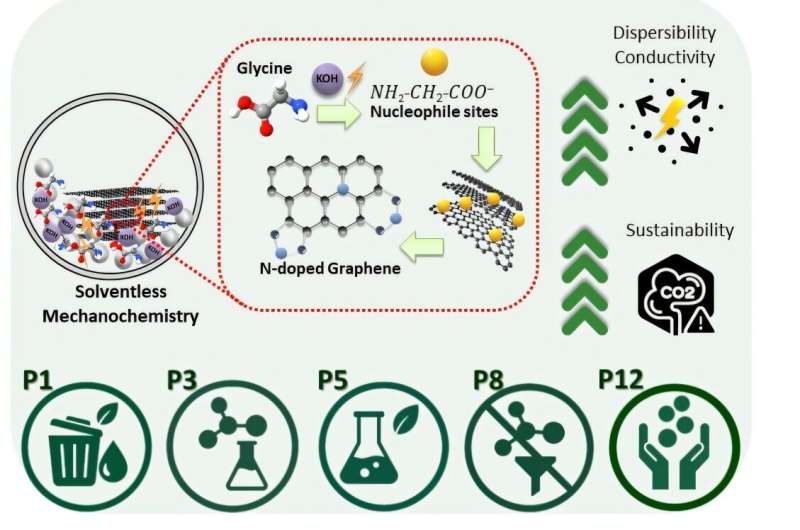
Researchers at Monash University have developed a groundbreaking method for producing nitrogen-doped graphene nanoplatelets using a more sustainable, solvent-free process. Published on December 25, 2025, in ACS Sustainable Chemistry & Engineering, this study addresses the environmental challenges associated with traditional graphene functionalization techniques, which often rely on toxic solvents and high-energy processes.
Challenges in Graphene Functionalization
Graphene is celebrated for its impressive properties, including strength, electrical conductivity, and thermal efficiency. However, the material’s full potential often remains untapped due to the complex processes required for its functionalization. Advanced applications, such as smart coatings and conductive composites, necessitate chemical modifications to enhance graphene’s dispersibility. Conventional methods for nitrogen doping, a common modification that improves graphene’s electronic structure, pose significant environmental concerns.
These traditional approaches frequently involve toxic nitrogen precursors, arduous purification steps, and high-temperature treatments exceeding 600 °C. Such processes generate considerable chemical waste, raising questions about their sustainability as the demand for eco-friendly manufacturing practices intensifies.
Innovative Mechanochemical Approach
The research team turned to mechanochemistry, a method that utilizes mechanical forces—such as shear, impact, and friction—to facilitate chemical reactions. This approach has garnered attention in green chemistry for its potential to eliminate solvents, reduce energy consumption, and simplify production processes.
In their study, the researchers employed a ball-milling technique to directly functionalize graphite with a bio-derived nitrogen source, specifically amino acids, under ambient conditions. By applying mechanical forces, they successfully broke and reformed chemical bonds in the solid state, producing nitrogen-doped graphene nanoplatelets (N-GNPs) without the need for solvents or toxic reagents.
The resulting N-GNPs not only maintained high electrical conductivity but also exhibited improved dispersibility, addressing two critical challenges in graphene processing simultaneously.
To assess the sustainability of their method, the researchers evaluated both qualitative and quantitative metrics. The production process achieved a high material yield of approximately 80%. Moreover, it demonstrated a significantly lower Environmental Factor (E-factor), a standard measure in green chemistry that quantifies waste generated per unit of product. By eliminating solvents and post-annealing steps, the overall energy usage was notably decreased.
Benefits of Nitrogen-Doped Graphene
The incorporation of nitrogen atoms into the graphene lattice alters electron movement, enhancing electrical conductivity and chemical reactivity. In their findings, the N-GNPs retained high structural quality while benefiting from the functional enhancements brought about by nitrogen incorporation. When utilized as nanofillers, these materials showed promise in improving the electrical, thermal, and mechanical properties of composite systems.
This balance between performance and sustainability is essential. The research underscores that green chemistry should not compromise material functionality but rather promote intelligent design from the outset.
Applications and Future Directions
One of the most promising outcomes of this research is the compatibility of N-GNPs with vitrimers, a class of polymers that combine the mechanical strength of thermosets with the reprocessability of thermoplastics. When integrated into vitrimer matrices, the nitrogen-doped graphene nanoplatelets can serve as multifunctional fillers, enabling electrically triggered self-healing, enhancing mechanical strength, and improving thermal and electrical conductivity. This innovation opens pathways for developing repairable coatings and recyclable composites, vital for sustainability-focused industries.
Although this research primarily focuses on graphene, it highlights a broader imperative: rethinking how advanced materials are manufactured. Many high-performance materials depend on outdated processes that overlook environmental impacts. The mechanochemical approach demonstrates that it is feasible to innovate while adhering to green chemistry principles, leading to reduced waste and energy consumption.
As industries in electronics, aerospace, and energy storage increasingly prioritize sustainability, the implications of this research extend far beyond graphene. Future studies will explore adapting this green synthesis technique to other dopants and composite systems, aiming to create scalable manufacturing routes that align with sustainability goals.
The pursuit of advanced functional materials will continue to drive innovation, and sustainable synthesis strategies will play a crucial role in shaping the technologies of tomorrow.

Robinhood Stock Surges 2.5% in Early Trading on March 17

Israel Intensifies Strikes as Global Energy Crisis Looms

CALV Offers Class on Communication Skills for Real Estate Professionals

Historic Bideford Pub Reopens as The Patch Wine Bar & Kitchen

Oscar Night Celebrations: Winners, Guests, and Exclusive After-Parties

Samsung Galaxy Watch 9 Set for Larger Battery Boost, Report Reveals

Kibble vs. Fresh Dog Food: What’s Best for Your Dog’s Health?

Acclaimed San Francisco Pizzeria Del Popolo to Close in May

‘Invincible’ Season 4 Launches on Prime Video with Epic Action

ALMA Discovers Companion Orbiting Giant Red Star π 1 Gruis

Doctoral Candidate Trivanni Yadav Advances Battery Research at UTulsa

Global Air Forces Ranked by Annual Defense Budgets in 2025

Rev. Bry Shields to Retire as McGill-Toolen President in 2026

Mass Production of F-35 Fighter Jet Drives Down Costs

Tucson Celebrates Life and Remembrance at 36th Annual All Souls Procession

Gold Investment Surge: Top Mutual Funds and ETF Alternatives

DirecTV to Launch AI-Driven Ads with User Likenesses in 2026

Paul Giamatti Reveals Villainous Role in Star Trek: Starfleet Academy
-
 Science9 months ago
ALMA Discovers Companion Orbiting Giant Red Star π 1 Gruis
-
 Science8 months ago
Doctoral Candidate Trivanni Yadav Advances Battery Research at UTulsa
-
 World10 months ago
Global Air Forces Ranked by Annual Defense Budgets in 2025
-
 Lifestyle10 months ago
Rev. Bry Shields to Retire as McGill-Toolen President in 2026
-
 World10 months ago
Mass Production of F-35 Fighter Jet Drives Down Costs
-
 Lifestyle9 months ago
Tucson Celebrates Life and Remembrance at 36th Annual All Souls Procession
-
 Business10 months ago
Gold Investment Surge: Top Mutual Funds and ETF Alternatives
-
 Top Stories10 months ago
DirecTV to Launch AI-Driven Ads with User Likenesses in 2026
-
 Entertainment10 months ago
Paul Giamatti Reveals Villainous Role in Star Trek: Starfleet Academy
-

 Lifestyle8 months ago
Maumee’s Shop With a Hero Event Delivers Joy to Local Children
-

 Top Stories10 months ago
New ‘Star Trek: Voyager’ Game Demo Released, Players Test Limits
-

 Lifestyle8 months ago
Cape May Shines as New Jersey’s Only Entry on Beach Town List