
Science
University of Pennsylvania Innovates Solar Sail Control with Kirigami

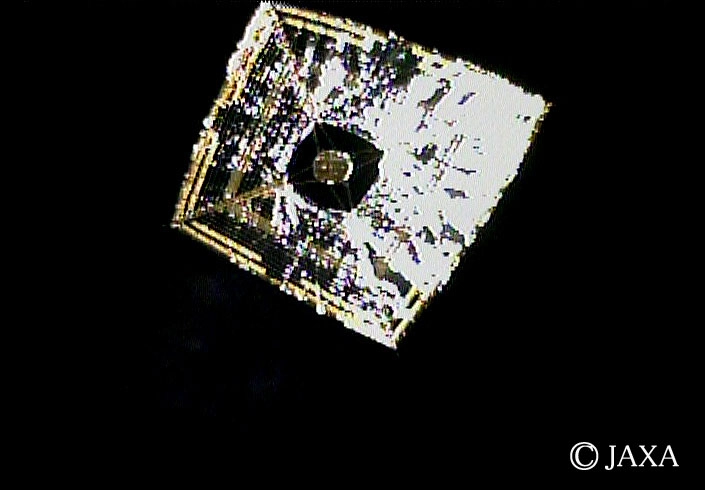
Researchers at the University of Pennsylvania have developed a novel technique for controlling solar sails, a promising technology for spacecraft propulsion that does not rely on traditional propellant. This innovative method, detailed in a pre-print paper available on arXiv, employs an ancient Japanese art form known as kirigami to enable precise adjustments in the sail’s angle, thereby enhancing its maneuverability in space.
Solar sails harness the momentum of sunlight, but turning them presents a unique challenge. Traditional sailing techniques, which involve adjusting the sail’s angle, are not applicable in the vacuum of space. Existing methods for turning solar sails often depend on heavy equipment such as reaction wheels, tip vanes, or Reflectivity Control Devices (RCDs). Each of these options has significant drawbacks, including weight, complexity, and energy consumption.
The technique introduced by Gulzhan Aldan and Igor Bargatin involves creating intentional cuts in the sail material, specifically in the aluminized polyimide film. These cuts allow the material to buckle when tension is applied, transforming the sail into a 3D surface. Each segment of the sail can reflect light at different angles, effectively turning the sail in the opposite direction of the reflected light due to the conservation of momentum.
While some power is required to create the necessary buckling, this is achieved using servo motors, which are notably more energy-efficient compared to the systems used in past solar sail missions. Unlike RCDs, which drain batteries even when not in operation, the kirigami method only consumes power while actively adjusting the sail.
To validate their approach, Aldan and Bargatin conducted both simulations and physical experiments. Using COMSOL, a well-established physics simulation software, they performed ray tracing experiments to measure the forces generated on the sail under varying conditions. Although the measured force was small—approximately 1 nN per Watt of sunlight—the cumulative effect is sufficient to maneuver a small solar sail and its payload over time.
In practical tests, the researchers cut sections of film and placed them in a test chamber. By illuminating the film with a laser while stretching it, they observed that the laser’s position on the chamber wall aligned closely with their simulations. This confirms the effectiveness of their kirigami design in achieving the desired angles of incidence under different strains.
The potential implications of this technology for the future of solar sailing are significant, particularly in reducing both energy and propellant costs associated with maneuvering. Yet, the competitive landscape remains challenging, with various technologies vying for dominance and a lack of extensive experimental missions to assess their viability.
As the field of solar sailing continues to evolve, the implementation of kirigami techniques could revolutionize how future spacecraft navigate the cosmos. Although it may take some time before this innovation is deployed in space missions, the prospect of a solar sail leveraging this technique promises to be visually and technically impressive.

Robinhood Stock Surges 2.5% in Early Trading on March 17

Israel Intensifies Strikes as Global Energy Crisis Looms

CALV Offers Class on Communication Skills for Real Estate Professionals

Historic Bideford Pub Reopens as The Patch Wine Bar & Kitchen

Oscar Night Celebrations: Winners, Guests, and Exclusive After-Parties

Samsung Galaxy Watch 9 Set for Larger Battery Boost, Report Reveals

Kibble vs. Fresh Dog Food: What’s Best for Your Dog’s Health?

Acclaimed San Francisco Pizzeria Del Popolo to Close in May

‘Invincible’ Season 4 Launches on Prime Video with Epic Action

ALMA Discovers Companion Orbiting Giant Red Star π 1 Gruis

Doctoral Candidate Trivanni Yadav Advances Battery Research at UTulsa

Global Air Forces Ranked by Annual Defense Budgets in 2025

Rev. Bry Shields to Retire as McGill-Toolen President in 2026

Mass Production of F-35 Fighter Jet Drives Down Costs

Tucson Celebrates Life and Remembrance at 36th Annual All Souls Procession

Gold Investment Surge: Top Mutual Funds and ETF Alternatives

DirecTV to Launch AI-Driven Ads with User Likenesses in 2026

Paul Giamatti Reveals Villainous Role in Star Trek: Starfleet Academy
-
 Science9 months ago
ALMA Discovers Companion Orbiting Giant Red Star π 1 Gruis
-
 Science9 months ago
Doctoral Candidate Trivanni Yadav Advances Battery Research at UTulsa
-
 World10 months ago
Global Air Forces Ranked by Annual Defense Budgets in 2025
-
 Lifestyle10 months ago
Rev. Bry Shields to Retire as McGill-Toolen President in 2026
-
 World10 months ago
Mass Production of F-35 Fighter Jet Drives Down Costs
-
 Lifestyle9 months ago
Tucson Celebrates Life and Remembrance at 36th Annual All Souls Procession
-
 Business10 months ago
Gold Investment Surge: Top Mutual Funds and ETF Alternatives
-
 Top Stories10 months ago
DirecTV to Launch AI-Driven Ads with User Likenesses in 2026
-
 Entertainment10 months ago
Paul Giamatti Reveals Villainous Role in Star Trek: Starfleet Academy
-

 Lifestyle8 months ago
Maumee’s Shop With a Hero Event Delivers Joy to Local Children
-

 Lifestyle8 months ago
Cape May Shines as New Jersey’s Only Entry on Beach Town List
-

 Top Stories10 months ago
New ‘Star Trek: Voyager’ Game Demo Released, Players Test Limits