
Science
Scientists Use X-rays to Uncover Ancient Star Map in California

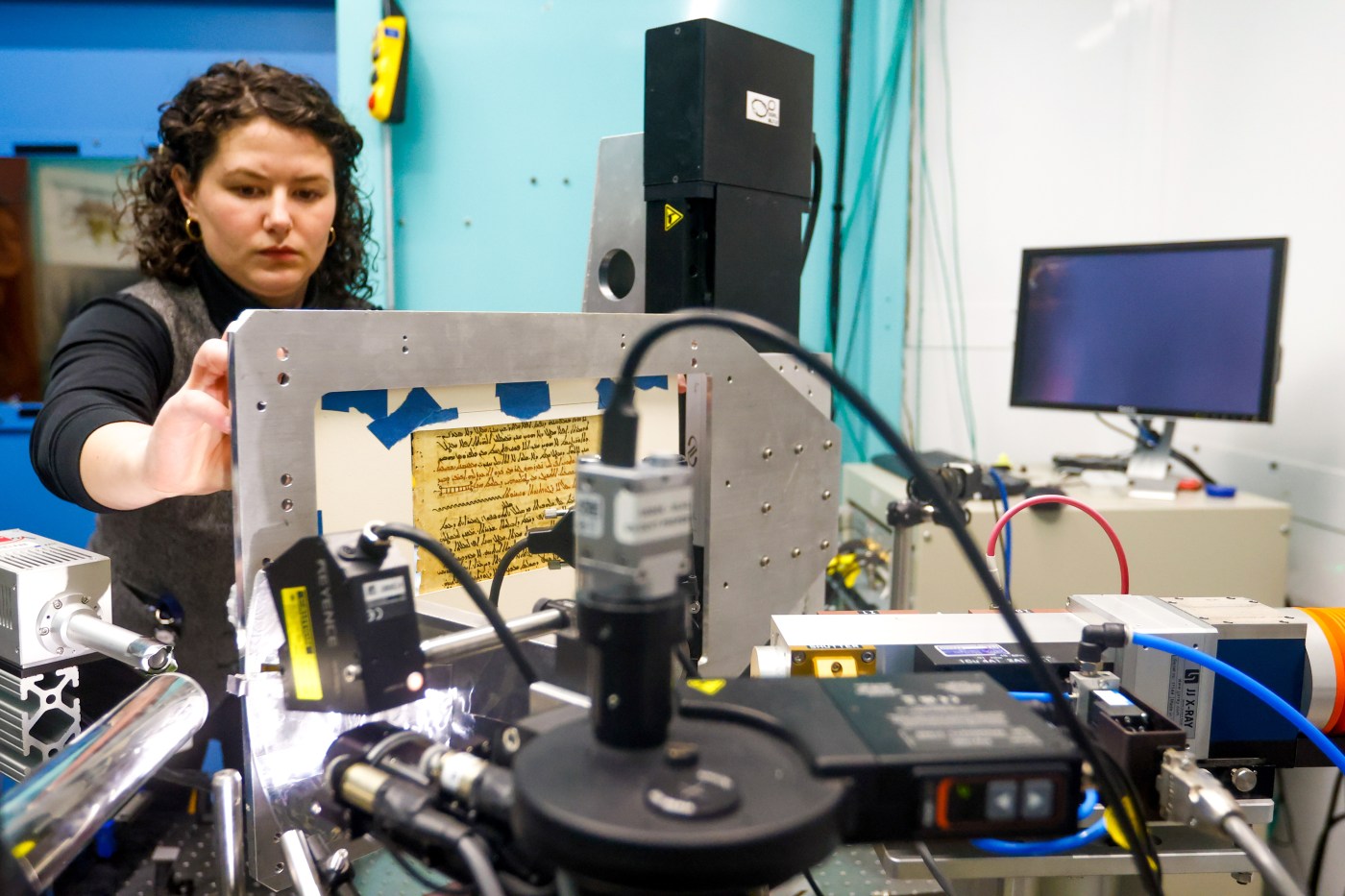
Researchers at the SLAC National Accelerator Laboratory in Menlo Park, California, are employing advanced X-ray technology to explore ancient parchment pages believed to contain remnants of the world’s oldest star map. This star map, created over 2,100 years ago by the Greek astronomer Hipparchus, is thought to catalog more than 800 celestial bodies, detailing their brightness and positions in the night sky.
The original document has yet to be discovered, and its existence is primarily known through references by historians such as Pliny the Elder in the first century. In recent years, however, a manuscript found at a medieval monastery in Egypt’s Sinai Desert has garnered attention. This manuscript, inscribed around the 6th Century, was overwritten by Christian texts, but initial imaging hinted at the presence of the ancient star map.
On Wednesday morning, lead scholar Victor Gysembergh from the French National Centre for Scientific Research revealed his excitement as imagery began appearing on screens during the X-ray scans. “We just have line after line of text showing up, in ancient Greek from the astronomical manuscript. I’m hoping to see the first star coordinates pop up,” he stated, emphasizing the significance of the findings. “We expect this to be a real game-changer. It will answer some big questions about how astronomy was born.”
The manuscript, known as the Codex Climaci Rescriptus, was found in 2012 by an undergraduate student at the University of Cambridge. Within its pages were faint references to astronomy. Further analysis over the following years linked these findings to Hipparchus’s period in the second century B.C., supported by later astronomers like Ptolemy.
At SLAC, scientists are meticulously examining each of the 22 pages of the manuscript, which are about the size of hardcover book pages. Each side of the pages contains both the visible inscriptions by monks and nearly erased sections of the star map. The X-ray technology being utilized is significantly more powerful than standard medical X-rays, enabling researchers to detect minute chemical traces of inks that have been overwritten.
The parchment was transported to SLAC from the Museum of the Bible in Washington, D.C., secured in a moisture-controlled case. Researchers carefully position each page in front of a steel nozzle that emits X-rays from the particle accelerator. This process allows them to differentiate between the inks used by the monks and those from the original star map, which were made from tannin-rich oak galls.
As the scanning progressed, Gysembergh observed the emergence of the constellation Aquarius, along with references to bright stars within it. “It could be a section where the manuscript is counting how many stars there are in a constellation, which would be great,” he noted. The accuracy of the coordinates being revealed is remarkable, considering they were created without the aid of telescopes.
The research conducted at SLAC is part of a broader initiative to utilize particle accelerator technology for historical document analysis. In 2022, researchers successfully examined fragile pages of the Gutenberg Bible and ancient Confucian texts, seeking to understand the origins of the printing press.
As the team continues to work on the Codex Climaci Rescriptus, there remains optimism about uncovering more of Hipparchus’s lost star map. This endeavor not only aims to shed light on ancient astronomical practices but also to enrich our understanding of humanity’s historical quest for knowledge about the cosmos.

Robinhood Stock Surges 2.5% in Early Trading on March 17

Israel Intensifies Strikes as Global Energy Crisis Looms

CALV Offers Class on Communication Skills for Real Estate Professionals

Historic Bideford Pub Reopens as The Patch Wine Bar & Kitchen

Oscar Night Celebrations: Winners, Guests, and Exclusive After-Parties

Samsung Galaxy Watch 9 Set for Larger Battery Boost, Report Reveals

Kibble vs. Fresh Dog Food: What’s Best for Your Dog’s Health?

Acclaimed San Francisco Pizzeria Del Popolo to Close in May

‘Invincible’ Season 4 Launches on Prime Video with Epic Action

ALMA Discovers Companion Orbiting Giant Red Star π 1 Gruis

Doctoral Candidate Trivanni Yadav Advances Battery Research at UTulsa

Global Air Forces Ranked by Annual Defense Budgets in 2025

Rev. Bry Shields to Retire as McGill-Toolen President in 2026

Mass Production of F-35 Fighter Jet Drives Down Costs

Tucson Celebrates Life and Remembrance at 36th Annual All Souls Procession

Gold Investment Surge: Top Mutual Funds and ETF Alternatives

DirecTV to Launch AI-Driven Ads with User Likenesses in 2026

Paul Giamatti Reveals Villainous Role in Star Trek: Starfleet Academy
-
 Science9 months ago
ALMA Discovers Companion Orbiting Giant Red Star π 1 Gruis
-
 Science8 months ago
Doctoral Candidate Trivanni Yadav Advances Battery Research at UTulsa
-
 World10 months ago
Global Air Forces Ranked by Annual Defense Budgets in 2025
-
 Lifestyle10 months ago
Rev. Bry Shields to Retire as McGill-Toolen President in 2026
-
 World10 months ago
Mass Production of F-35 Fighter Jet Drives Down Costs
-
 Lifestyle9 months ago
Tucson Celebrates Life and Remembrance at 36th Annual All Souls Procession
-
 Business10 months ago
Gold Investment Surge: Top Mutual Funds and ETF Alternatives
-
 Top Stories10 months ago
DirecTV to Launch AI-Driven Ads with User Likenesses in 2026
-
 Entertainment10 months ago
Paul Giamatti Reveals Villainous Role in Star Trek: Starfleet Academy
-

 Lifestyle8 months ago
Maumee’s Shop With a Hero Event Delivers Joy to Local Children
-

 Top Stories10 months ago
New ‘Star Trek: Voyager’ Game Demo Released, Players Test Limits
-

 Lifestyle7 months ago
Cape May Shines as New Jersey’s Only Entry on Beach Town List