
Health
Health Officials Investigate Aluminum Salts in Childhood Vaccines

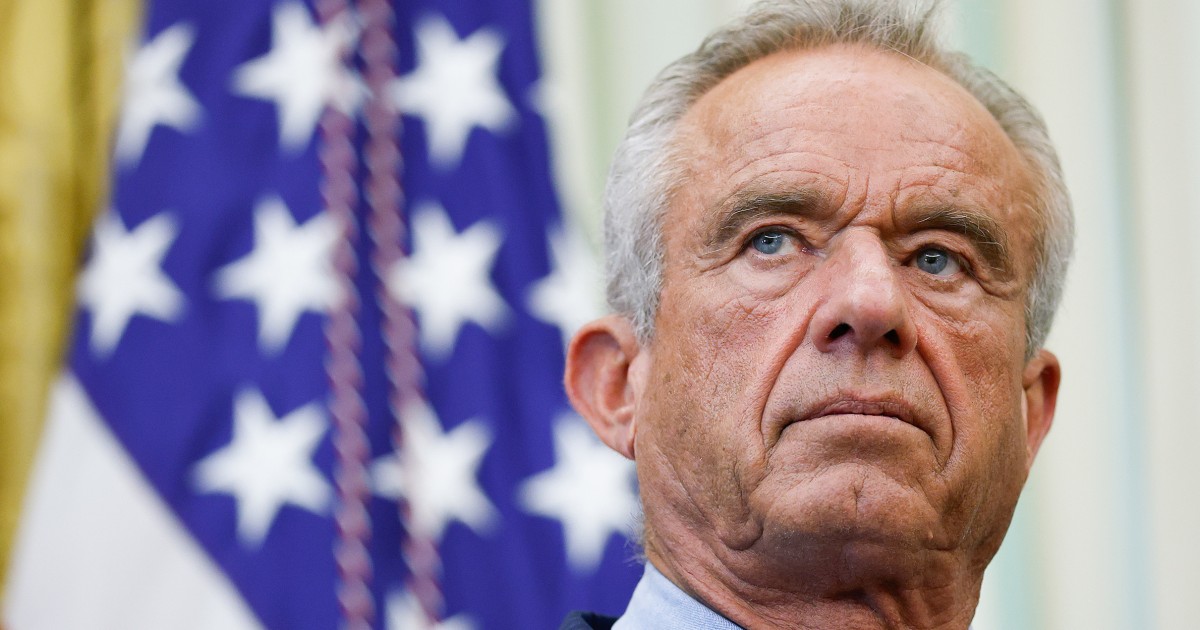
Health officials in the United States are currently scrutinizing aluminum salts, an ingredient commonly found in childhood vaccines. This evaluation comes under the leadership of Secretary of Health Robert F. Kennedy Jr., hinting at potential changes in the recommended vaccine schedule in the near future. The Centers for Disease Control and Prevention (CDC) recently indicated that concerns regarding aluminum salts are being examined, despite extensive studies demonstrating their safety.
Earlier this month, members of the CDC’s vaccine advisory committee, appointed by Kennedy after a staff overhaul, suggested a thorough review of aluminum salts. Andrew Nixon, a spokesperson for the Department of Health and Human Services (HHS), stated that the committee is “reviewing the body of science related to aluminum and other possible contaminants in childhood vaccines.” Notably, a recent statement on the CDC website mentioned that HHS is investigating potential links between aluminum in vaccines and autism.
Aluminum salts serve as adjuvants, enhancing the immune response to vaccines, thereby allowing for smaller dosages. This compound has been used safely for nearly a century, and it naturally occurs in the environment. Research indicates that the amount of aluminum children receive from vaccines is significantly lower than their daily exposure from food and water. For instance, exposure from infant formula or breast milk often surpasses that from vaccines in the initial six months of life.
Dr. Michelle Fiscus, chief medical officer at the Association of Immunization Managers, explained, “The purpose of aluminum salts is to help the immune system respond more robustly to vaccines.” She emphasized that aluminum adjuvants have significantly enhanced vaccine effectiveness, contributing to a marked reduction in illness and mortality.
In recent months, skepticism regarding aluminum has emerged repeatedly during federal health discussions. For instance, former President Donald Trump claimed in September that aluminum was being removed from vaccines, linking the use of Tylenol during pregnancy to autism, despite minimal scientific support for such claims. During the CDC advisory panel meeting, Dr. Tracy Beth Høeg from the FDA advocated for adopting a vaccine schedule similar to Denmark’s, suggesting it could reduce aluminum exposure.
Public health experts express concern that the renewed focus on aluminum may reflect a broader agenda to limit childhood vaccinations. Recently, HHS delayed an announcement regarding children’s health, with reports suggesting potential reductions in recommended vaccines. The CDC advisory committee has already ceased recommending the hepatitis B vaccine for all newborns, allowing parents who test negative for the virus to consult with healthcare providers regarding vaccination.
Changing vaccine recommendations based on aluminum salt concerns could undermine public health efforts, according to several experts. Notably, many vaccines recommended in Denmark also contain aluminum salts. Among the pediatric vaccines absent from Denmark’s recommendations, only three—hepatitis A, hepatitis B, and meningococcal vaccines—contain aluminum salts. Other vaccines on the CDC schedule, including those for respiratory syncytial virus (RSV), rotavirus, flu, and chickenpox, do not.
The combination measles, mumps, and rubella vaccine, often mistakenly associated with autism by anti-vaccine advocates, also does not contain aluminum salts. A large-scale study involving over 1.2 million children in Denmark, published in July 2023 in the journal Annals of Internal Medicine, found no connection between aluminum salts in vaccines and neurodevelopmental disorders, including autism. Despite this, Kennedy has called for the study’s retraction, labeling it as flawed and biased.
Kennedy’s historical involvement with the anti-vaccine movement and his assertions regarding aluminum and rising rates of allergies and autism have drawn criticism. His organization, Children’s Health Defense, has long claimed that thimerosal, a mercury-based preservative, is linked to autism. He has argued that aluminum has replaced thimerosal in some vaccines, implying a continued risk. In reality, aluminum salts and thimerosal serve distinct purposes, and aluminum has been a safe ingredient in vaccines for decades. Thimerosal was largely phased out of childhood vaccines in 2001.
A recent analysis from the World Health Organization found no correlation between autism and vaccines containing either thimerosal or aluminum. Dr. Fiscus noted that the ongoing attempts to implicate vaccines in the development of diseases are unsupported by scientific evidence.
In 2021, Kennedy claimed that all vaccines containing aluminum posed “negative risk profiles” and suggested that children’s brains might be “loaded with aluminum.” Contrarily, a significant German study in 2011 did not find an increased risk of allergies in vaccinated children and even reported a decrease in hay fever among them. A more recent study in 2023 suggested a potential link between aluminum exposure from vaccines and persistent asthma, yet researchers noted that the results were not replicable and lacked adequate controls.
In response to growing concerns regarding aluminum salts, Dr. Seth Ari Sim-Son Hoffman, a physician-scientist at Stanford Medicine, and colleagues reanalyzed existing data. Their findings, published this month in the journal Pediatrics, indicated no major safety concerns associated with aluminum-containing vaccines. The most common side effects reported were limited to localized redness and swelling at the injection site. Hoffman remarked, “When you see the same ‘no’ finding or ‘no’ association across multiple countries, multiple study designs, and over a million children, that’s really clear and reassuring.” He affirmed that the current childhood vaccine schedule in the U.S. is supported by robust evidence regarding safety and effectiveness.
The ongoing investigation into aluminum salts highlights the complexities and challenges surrounding vaccine safety discourse. As public health officials navigate these discussions, the emphasis remains on ensuring that vaccines continue to be not only effective but also safe for the populations they serve.

Robinhood Stock Surges 2.5% in Early Trading on March 17

Israel Intensifies Strikes as Global Energy Crisis Looms

CALV Offers Class on Communication Skills for Real Estate Professionals

Historic Bideford Pub Reopens as The Patch Wine Bar & Kitchen

Oscar Night Celebrations: Winners, Guests, and Exclusive After-Parties

Samsung Galaxy Watch 9 Set for Larger Battery Boost, Report Reveals

Kibble vs. Fresh Dog Food: What’s Best for Your Dog’s Health?

Acclaimed San Francisco Pizzeria Del Popolo to Close in May

‘Invincible’ Season 4 Launches on Prime Video with Epic Action

ALMA Discovers Companion Orbiting Giant Red Star π 1 Gruis

Doctoral Candidate Trivanni Yadav Advances Battery Research at UTulsa

Rev. Bry Shields to Retire as McGill-Toolen President in 2026

Global Air Forces Ranked by Annual Defense Budgets in 2025

Tucson Celebrates Life and Remembrance at 36th Annual All Souls Procession

Mass Production of F-35 Fighter Jet Drives Down Costs

Gold Investment Surge: Top Mutual Funds and ETF Alternatives

DirecTV to Launch AI-Driven Ads with User Likenesses in 2026

Maumee’s Shop With a Hero Event Delivers Joy to Local Children
-
 Science9 months ago
ALMA Discovers Companion Orbiting Giant Red Star π 1 Gruis
-
 Science9 months ago
Doctoral Candidate Trivanni Yadav Advances Battery Research at UTulsa
-
 Lifestyle10 months ago
Rev. Bry Shields to Retire as McGill-Toolen President in 2026
-
 World10 months ago
Global Air Forces Ranked by Annual Defense Budgets in 2025
-
 Lifestyle10 months ago
Tucson Celebrates Life and Remembrance at 36th Annual All Souls Procession
-
 World10 months ago
Mass Production of F-35 Fighter Jet Drives Down Costs
-
 Business10 months ago
Gold Investment Surge: Top Mutual Funds and ETF Alternatives
-
 Top Stories10 months ago
DirecTV to Launch AI-Driven Ads with User Likenesses in 2026
-
 Lifestyle8 months ago
Maumee’s Shop With a Hero Event Delivers Joy to Local Children
-

 Sports8 months ago
Lawrence Launches Winterfest Skating Rink and Hot Chocolate Chalet
-

 Entertainment10 months ago
Paul Giamatti Reveals Villainous Role in Star Trek: Starfleet Academy
-

 Lifestyle8 months ago
Cape May Shines as New Jersey’s Only Entry on Beach Town List