
Science
Astronomers Discover Evidence of Ancient “Monster Stars”

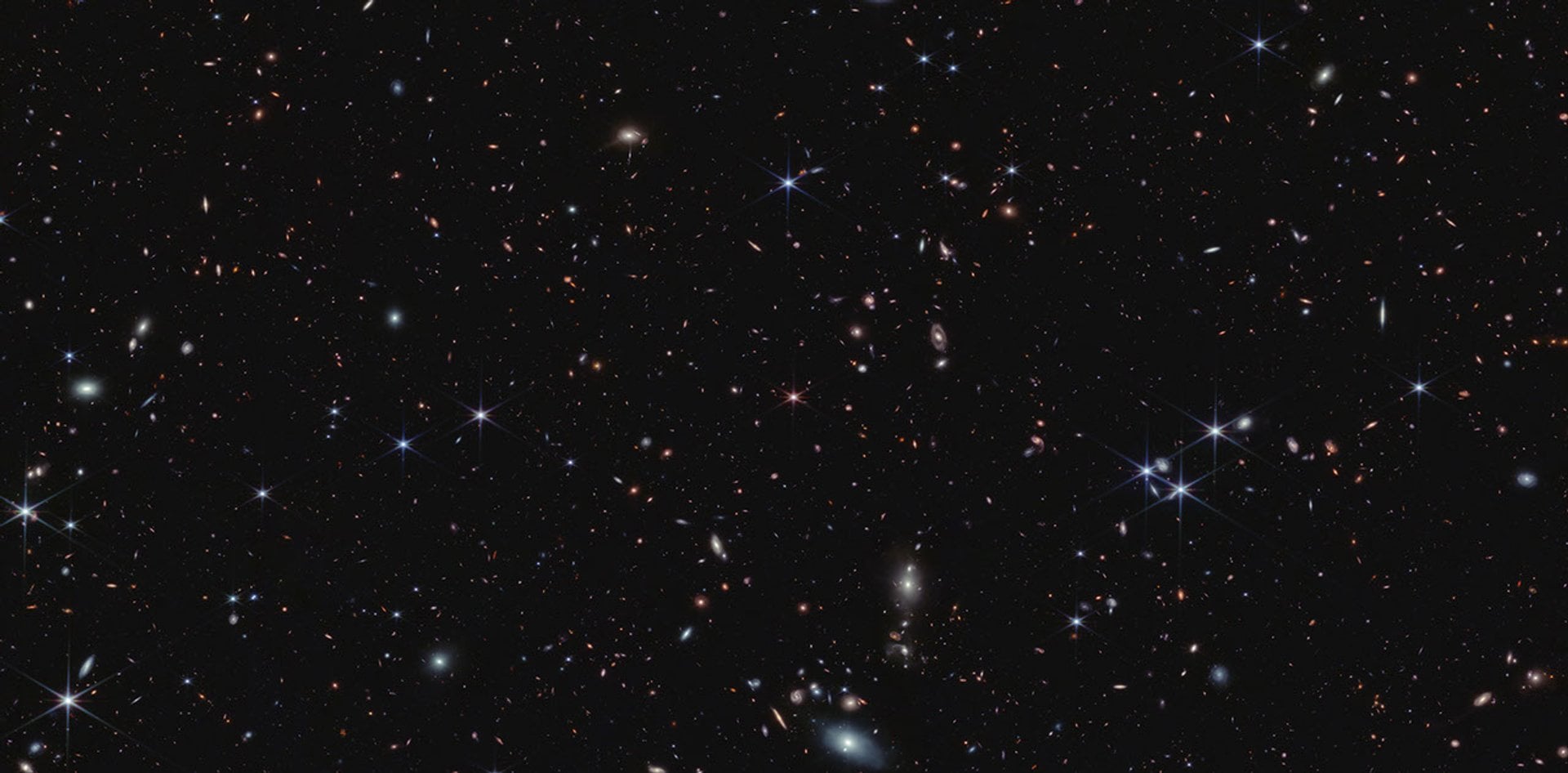
A team of astronomers has made a significant breakthrough in understanding the early universe by uncovering the first compelling evidence of “monster stars” that existed shortly after the Big Bang. Using the James Webb Space Telescope (JWST), researchers led by Devesh Nandal from the University of Virginia and the Institute for Theory and Computation at the Harvard & Smithsonian Center for Astrophysics have found indications that these massive stars, ranging from 1,000 to 10,000 solar masses, may have played a crucial role in the formation of supermassive black holes (SMBHs).
For over two decades, scientists have been baffled by the presence of SMBHs—gravitational giants weighing millions to billions of solar masses—less than a billion years after the Big Bang. Traditional models suggest that there was insufficient time for these massive black holes to form through standard processes, leading to an alternative theory: the direct collapse of massive gas clouds, which could give rise to black hole “seeds.” This new evidence supports the hypothesis that Population III stars, the first stars in the universe, existed and were massive enough to leave behind black holes.
Understanding GS 3073 and Its Significance
The research team examined the galaxy GS 3073, initially identified in 2022 by Muhammad A. Latif, Daniel Whalen, and their colleagues from the Institute for Astronomy at the University of Edinburgh and other institutions. They discovered an extreme nitrogen-to-oxygen ratio of 0.46 in GS 3073, a figure far beyond what known types of stars or stellar explosions could account for. This led them to propose that these early stars formed in turbulent flows of cold gas just a few hundred million years after the Big Bang.
GS 3073 also features an actively feeding black hole at its center, which the researchers suggest could be a remnant of one of these “monster stars.” This discovery aligns with the detection of multiple quasars by JWST that existed less than one billion years after the Big Bang, phenomena caused by SMBHs at the centers of galaxies that accelerate surrounding gas and dust to near-light speeds, releasing immense energy.
The Mechanism Behind Monster Stars
To validate their theory, Latif, Whalen, and their team modeled the evolution of stars in the range of 1,000 to 10,000 solar masses and the chemical products of their lifecycle. Their findings suggest that these monster stars fuse helium in their cores to produce carbon, which eventually combines with hydrogen to form nitrogen. This nitrogen is then circulated throughout the star and released into the surrounding environment.
“This process continues as long as helium is fused in the core, enriching the gas cloud until the observed nitrogen-to-oxygen ratio is achieved,” said Nandal in a press release from the University of Portsmouth.
Interestingly, the team concluded that these stars do not explode as supernovae at the end of their life cycles. Instead, they collapse directly into massive black holes, which could serve as the foundational seeds for the SMBHs we observe today. The nitrogen signature they identified was not present in stars outside this specific mass range, highlighting the uniqueness of these monster stars.
If confirmed, these findings could resolve two significant mysteries highlighted in previous JWST observations and provide new insights into the early universe’s dynamics between 380,000 and 1 billion years post-Big Bang, a period known as the “Cosmic Dark Ages.” Previously, the faint light from this era was too weak for conventional instruments to detect, making the advanced infrared capabilities of the JWST essential for this research.
The researchers anticipate that future surveys will uncover more galaxies exhibiting similar nitrogen excesses, potentially allowing for further exploration of the existence and implications of “monster stars” in the early universe.
As this research unfolds, it stands to reshape our understanding of cosmic evolution and the interplay between stellar formation and black hole development in the universe’s infancy.

Robinhood Stock Surges 2.5% in Early Trading on March 17

Israel Intensifies Strikes as Global Energy Crisis Looms

CALV Offers Class on Communication Skills for Real Estate Professionals

Historic Bideford Pub Reopens as The Patch Wine Bar & Kitchen

Oscar Night Celebrations: Winners, Guests, and Exclusive After-Parties

Samsung Galaxy Watch 9 Set for Larger Battery Boost, Report Reveals

Kibble vs. Fresh Dog Food: What’s Best for Your Dog’s Health?

Acclaimed San Francisco Pizzeria Del Popolo to Close in May

‘Invincible’ Season 4 Launches on Prime Video with Epic Action

ALMA Discovers Companion Orbiting Giant Red Star π 1 Gruis

Doctoral Candidate Trivanni Yadav Advances Battery Research at UTulsa

Global Air Forces Ranked by Annual Defense Budgets in 2025

Rev. Bry Shields to Retire as McGill-Toolen President in 2026

Mass Production of F-35 Fighter Jet Drives Down Costs

Tucson Celebrates Life and Remembrance at 36th Annual All Souls Procession

Gold Investment Surge: Top Mutual Funds and ETF Alternatives

DirecTV to Launch AI-Driven Ads with User Likenesses in 2026

Paul Giamatti Reveals Villainous Role in Star Trek: Starfleet Academy
-
 Science9 months ago
ALMA Discovers Companion Orbiting Giant Red Star π 1 Gruis
-
 Science8 months ago
Doctoral Candidate Trivanni Yadav Advances Battery Research at UTulsa
-
 World10 months ago
Global Air Forces Ranked by Annual Defense Budgets in 2025
-
 Lifestyle10 months ago
Rev. Bry Shields to Retire as McGill-Toolen President in 2026
-
 World10 months ago
Mass Production of F-35 Fighter Jet Drives Down Costs
-
 Lifestyle9 months ago
Tucson Celebrates Life and Remembrance at 36th Annual All Souls Procession
-
 Business10 months ago
Gold Investment Surge: Top Mutual Funds and ETF Alternatives
-
 Top Stories10 months ago
DirecTV to Launch AI-Driven Ads with User Likenesses in 2026
-
 Entertainment10 months ago
Paul Giamatti Reveals Villainous Role in Star Trek: Starfleet Academy
-

 Lifestyle8 months ago
Maumee’s Shop With a Hero Event Delivers Joy to Local Children
-

 Top Stories10 months ago
New ‘Star Trek: Voyager’ Game Demo Released, Players Test Limits
-

 Lifestyle8 months ago
Cape May Shines as New Jersey’s Only Entry on Beach Town List