
Science
New Instrument Proposal for HWO Aims to Identify Earth-like Planets

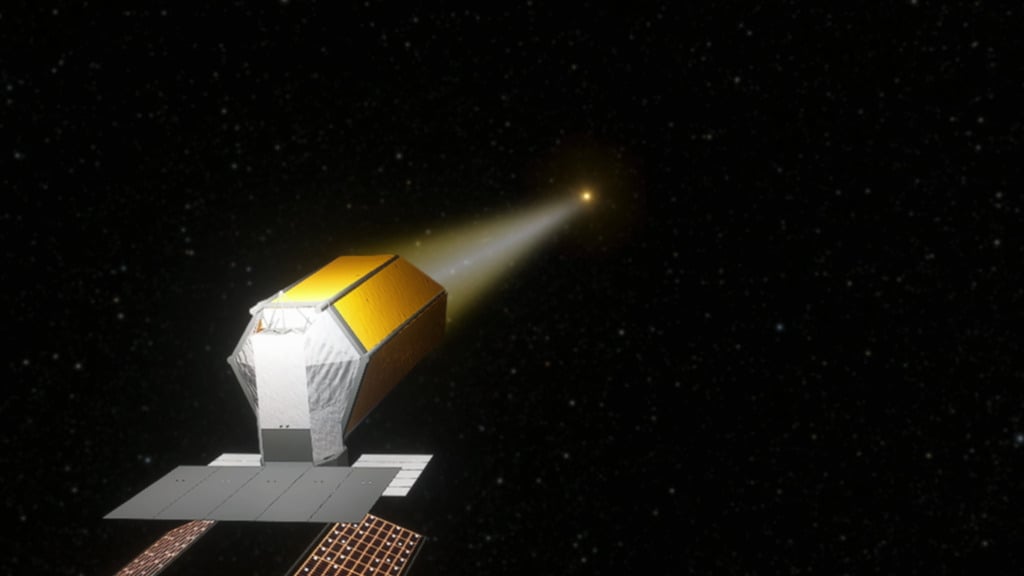
The proposed addition of a second instrument to the Habitable Worlds Observatory (HWO) could significantly enhance the search for Earth-like exoplanets. Currently, HWO’s primary tool is a coronagraph, which, while powerful, may not be sufficient for detecting the biosignatures of at least 25 Earth-like planets in the atmospheres surrounding nearby stars. A new paper authored by Fabien Malbet of the University of Grenoble Alpes and his colleagues suggests that incorporating an astrometric instrument could enable the observatory to track planets with a precision of 0.5 micro-arcseconds (μas). This precision could dramatically expand the number of potential candidates for atmospheric analysis.
As it stands, only 12% of sun-like stars within 65 light-years are confirmed to host planets, and all of these are gas giants. The absence of rocky exoplanets in this vicinity does not imply their non-existence; rather, the signals from such planets may be obscured by background noise from existing missions like Gaia. While Gaia is currently the most advanced planetary surveyor, it operates with a precision of approximately 20-30 μas, which is insufficient for detecting smaller planets like Earth.
Enhancing Precision in Exoplanet Detection
The proposed astrometric instrument would offer a precision advantage of 400-600 times that of Gaia, enabling HWO to discover Earth-sized planets around hundreds of nearby stars. Achieving this remarkable precision hinges on two crucial components: a sophisticated calibrator and extensive imaging. Astrometric sensors have been utilized for decades to detect exoplanets by measuring the “wobble” of stars caused by orbiting planets. The greater the precision, the smaller the wobble that can be detected, thereby allowing astronomers to identify smaller planetary masses.
Despite their advantages, astrometric methods are susceptible to errors stemming from various factors, including imperfections in detectors or misalignments in mirrors. To overcome these challenges, the authors propose a technology called a Detector Calibration Unit (DCU). This unit would generate a pattern of light and dark bands across the CMOS sensor, facilitating the isolation and correction of small errors before they escalate. By ensuring the precise calibration of each pixel in the sensor’s field, researchers can enhance the stability of multiple images.
Dr. Malbet and his team suggest that HWO would need to gather over 100 individual measurements of a single target star during its operational lifespan of 3-4 years to reach the necessary precision for confirming a planet’s existence. This extensive data collection is vital to offset any random errors that the DCU does not correct, as combining numerous images minimizes the impact of residual inaccuracies.
Broader Implications for Astrophysics
The implications of this advanced technology extend beyond exoplanet detection. The new astrometer could provide insights into Cold Dark Matter (CDM) theories, particularly regarding the distribution of dark matter in galaxies. Current CDM theory posits that dark matter is concentrated in “cusps” at the centers of galaxies. However, observational data indicates a more “core-like” structure. HWO’s astrometer may detect subtle gravitational effects from dark matter “spikes,” contributing to our understanding of the forces shaping these structures.
While this concept is not entirely new—Dr. Malbet was instrumental in the earlier Theia mission proposal, which aimed to utilize similar principles—the integration of this technology into HWO represents a logical progression. Given that HWO is fundamentally dedicated to identifying habitable worlds, any enhancement that aids this mission is valuable.
Development of the HWO is not expected to commence in earnest until the 2030s, with a potential launch in the 2040s. This timeline allows ample opportunity for the integration of the proposed astrometric instrument. The project manager’s willingness to embrace these ambitions will ultimately determine whether this innovative advancement will be realized within the observatory’s framework.
The potential for HWO to revolutionize our understanding of exoplanets and dark matter alike illustrates the importance of continual innovation in astrophysics. As the quest for habitable worlds continues, tools that enhance our observational capabilities will be crucial for future discoveries.

Robinhood Stock Surges 2.5% in Early Trading on March 17

Israel Intensifies Strikes as Global Energy Crisis Looms

CALV Offers Class on Communication Skills for Real Estate Professionals

Historic Bideford Pub Reopens as The Patch Wine Bar & Kitchen

Oscar Night Celebrations: Winners, Guests, and Exclusive After-Parties

Samsung Galaxy Watch 9 Set for Larger Battery Boost, Report Reveals

Kibble vs. Fresh Dog Food: What’s Best for Your Dog’s Health?

Acclaimed San Francisco Pizzeria Del Popolo to Close in May

‘Invincible’ Season 4 Launches on Prime Video with Epic Action

ALMA Discovers Companion Orbiting Giant Red Star π 1 Gruis

Doctoral Candidate Trivanni Yadav Advances Battery Research at UTulsa

Global Air Forces Ranked by Annual Defense Budgets in 2025

Rev. Bry Shields to Retire as McGill-Toolen President in 2026

Mass Production of F-35 Fighter Jet Drives Down Costs

Tucson Celebrates Life and Remembrance at 36th Annual All Souls Procession

Gold Investment Surge: Top Mutual Funds and ETF Alternatives

DirecTV to Launch AI-Driven Ads with User Likenesses in 2026

Paul Giamatti Reveals Villainous Role in Star Trek: Starfleet Academy
-
 Science9 months ago
ALMA Discovers Companion Orbiting Giant Red Star π 1 Gruis
-
 Science8 months ago
Doctoral Candidate Trivanni Yadav Advances Battery Research at UTulsa
-
 World10 months ago
Global Air Forces Ranked by Annual Defense Budgets in 2025
-
 Lifestyle9 months ago
Rev. Bry Shields to Retire as McGill-Toolen President in 2026
-
 World10 months ago
Mass Production of F-35 Fighter Jet Drives Down Costs
-
 Lifestyle9 months ago
Tucson Celebrates Life and Remembrance at 36th Annual All Souls Procession
-
 Business10 months ago
Gold Investment Surge: Top Mutual Funds and ETF Alternatives
-
 Top Stories10 months ago
DirecTV to Launch AI-Driven Ads with User Likenesses in 2026
-
 Entertainment10 months ago
Paul Giamatti Reveals Villainous Role in Star Trek: Starfleet Academy
-

 Top Stories10 months ago
New ‘Star Trek: Voyager’ Game Demo Released, Players Test Limits
-

 Lifestyle8 months ago
Maumee’s Shop With a Hero Event Delivers Joy to Local Children
-

 Lifestyle7 months ago
Cape May Shines as New Jersey’s Only Entry on Beach Town List