
Top Stories
Researchers Link Prime Numbers to Black Hole Mysteries

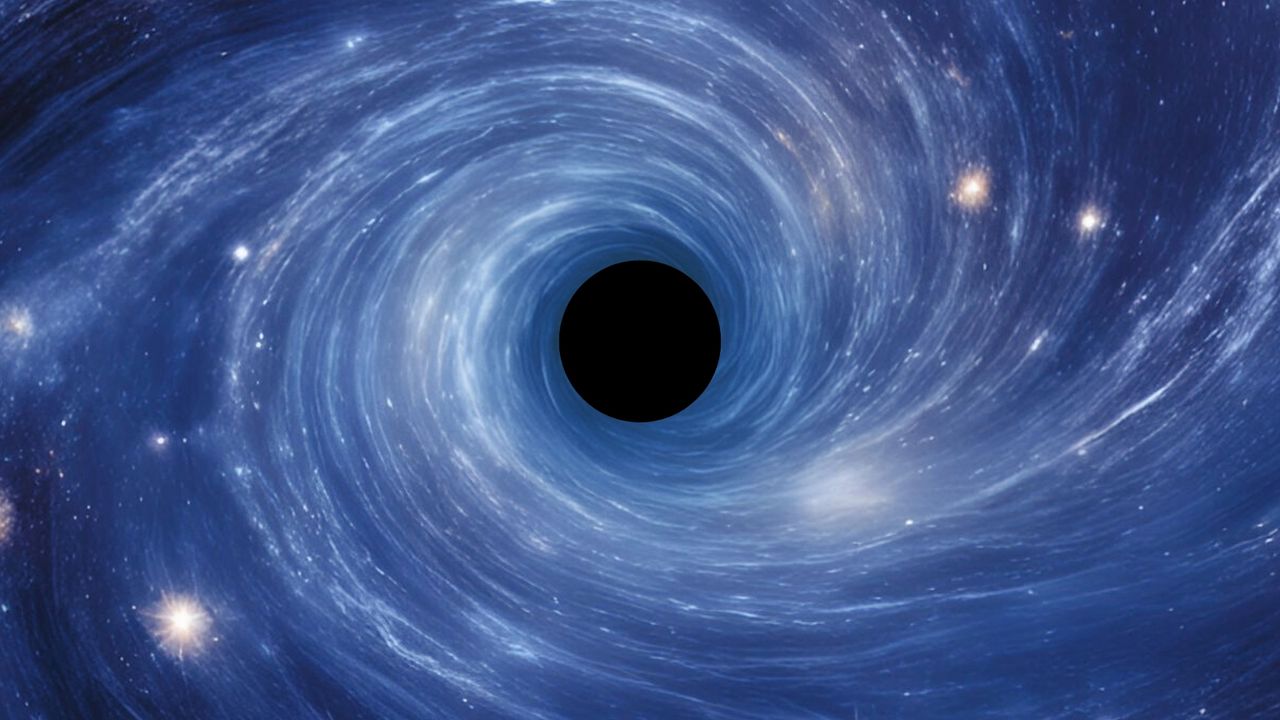
Recent research reveals that prime numbers, fundamental elements in mathematics, may hold significant insights into the complex nature of black holes. Over the past year, scientists have identified connections between prime number theories and the chaotic behavior observed in the vicinity of black holes, opening new avenues for understanding some of the universe’s most enigmatic phenomena.
Prime numbers, which can only be divided by themselves and one, have long been a focus of number theory. In a landmark study, physicists have begun to explore how these mathematical entities can describe features within the gravitational forces surrounding black holes. As researchers delve deeper, they are uncovering potential links between mathematical principles and the fundamental laws of physics.
Exploring the Connection Between Chaos and Prime Numbers
At the heart of black holes lies a singularity, a point where classical physics suggests that gravity becomes infinite, leading to a breakdown of our understanding of space and time. In the 1960s, physicists discovered a chaotic behavior emerging just outside this singularity, which has now been found to mirror the chaos associated with prime numbers.
Eric Perlmutter from the Institute of Theoretical Physics in Saclay noted that many high-energy physicists remain unaware of the implications of number theory in their field. This raises intriguing possibilities about how the chaos near a singularity may be influenced by the properties of prime numbers.
The foundational conjecture in number theory, known as the Riemann hypothesis, proposed by German mathematician Bernhard Riemann in 1859, suggests that prime numbers can be estimated using a specific formula that incorporates the zeta function. The zeros of this function, where it equals zero, enhance the accuracy of prime number estimates. Proving the Riemann hypothesis is so significant that it carries a reward of $1 million from the Clay Mathematics Institute.
From Theoretical Concepts to Practical Applications
Interest in the intersection of prime numbers and black hole physics began to surface in the late 1980s. Bernard Julia from the École Normale Supérieure proposed a theoretical particle, termed “primons,” whose energy levels correspond to the logarithms of prime numbers. This concept linked the partition function of a hypothetical primon gas to the Riemann zeta function, though at the time, many scientists were skeptical of its practical relevance.
Fast forward two decades, and researchers such as Yan Fyodorov from King’s College London, Ghaith Hiary from Ohio State University, and Jon Keating from the University of Oxford found that fractal chaos, arising from the fluctuations of the zeta function’s zeros, has real implications in black hole physics. Their findings, published in 2025, established a concrete link between these mathematical concepts and the chaotic nature near black hole singularities.
In a recent preprint, Sean Hartnoll from the University of Cambridge and graduate student Ming Yang extended Julia’s theories into practical applications. They discovered that a “conformal” symmetry emerges in the chaotic environment close to a singularity, allowing for a new understanding of quantum systems that could be organized into prime numbers, thus forming a “conformal primon gas cloud.”
The research team later expanded their analysis to a five-dimensional universe, leading to the discovery that the dynamics of singularities require complex prime numbers, known as Gaussian primes, which include imaginary components. This evolution in their understanding has resulted in the concept of a “complex primon gas.”
Hartnoll expressed intrigue over the implications of prime number randomness near singularities, stating, “We don’t know yet whether the appearance of prime number randomness close to a singularity has a deeper meaning.” He emphasized the potential for higher-dimensional theories of gravity to shed light on these complex relationships.
In a separate analysis, Perlmutter introduced a new framework involving the zeta zeros that extends beyond integers to encompass all real numbers, including irrational numbers. This broader perspective could unlock advanced techniques for addressing quantum gravity.
Jon Keating, not directly involved in the recent research, highlighted the importance of stepping back to view the broader landscape of scientific inquiry. He noted, “It’s only when you step back and look at the whole mountain that you think, ‘Ah, there’s a much better way to get up over there.'”
As the research community continues to explore these connections, there is cautious optimism that understanding the relationship between prime numbers and black holes will lead to significant advancements in theoretical physics. Perlmutter suggests that the ongoing exploration of prime physics could accelerate discoveries, as scientists seek to understand the intricate structures that govern black holes and quantum gravity.
The implications of this research could extend far beyond mathematics and physics, potentially reshaping our understanding of the universe. As these developments unfold, the scientific community remains focused on uncovering the deeper truths hidden within the chaos of black holes and prime numbers.

Robinhood Stock Surges 2.5% in Early Trading on March 17

Israel Intensifies Strikes as Global Energy Crisis Looms

CALV Offers Class on Communication Skills for Real Estate Professionals

Historic Bideford Pub Reopens as The Patch Wine Bar & Kitchen

Oscar Night Celebrations: Winners, Guests, and Exclusive After-Parties

Samsung Galaxy Watch 9 Set for Larger Battery Boost, Report Reveals

Kibble vs. Fresh Dog Food: What’s Best for Your Dog’s Health?

Acclaimed San Francisco Pizzeria Del Popolo to Close in May

‘Invincible’ Season 4 Launches on Prime Video with Epic Action

ALMA Discovers Companion Orbiting Giant Red Star π 1 Gruis

Doctoral Candidate Trivanni Yadav Advances Battery Research at UTulsa

Global Air Forces Ranked by Annual Defense Budgets in 2025

Mass Production of F-35 Fighter Jet Drives Down Costs

Rev. Bry Shields to Retire as McGill-Toolen President in 2026

Gold Investment Surge: Top Mutual Funds and ETF Alternatives

DirecTV to Launch AI-Driven Ads with User Likenesses in 2026

New ‘Star Trek: Voyager’ Game Demo Released, Players Test Limits

Paul Giamatti Reveals Villainous Role in Star Trek: Starfleet Academy
-
 Science7 months ago
ALMA Discovers Companion Orbiting Giant Red Star π 1 Gruis
-
 Science7 months ago
Doctoral Candidate Trivanni Yadav Advances Battery Research at UTulsa
-
 World8 months ago
Global Air Forces Ranked by Annual Defense Budgets in 2025
-
 World8 months ago
Mass Production of F-35 Fighter Jet Drives Down Costs
-
 Lifestyle8 months ago
Rev. Bry Shields to Retire as McGill-Toolen President in 2026
-
 Business8 months ago
Gold Investment Surge: Top Mutual Funds and ETF Alternatives
-
 Top Stories8 months ago
DirecTV to Launch AI-Driven Ads with User Likenesses in 2026
-
 Top Stories8 months ago
New ‘Star Trek: Voyager’ Game Demo Released, Players Test Limits
-
 Entertainment8 months ago
Paul Giamatti Reveals Villainous Role in Star Trek: Starfleet Academy
-

 Entertainment8 months ago
Freeport Art Gallery Transforms Waste into Creative Masterpieces
-

 Entertainment8 months ago
Fast & Furious Coaster Hits the Track at Universal Studios
-

 Science8 months ago
NTSB Report Reveals Hull Damage Caused Titan Submersible Implosion