
Science
Astronomers Discover Cloud-9: A New Class of Starless Galaxy

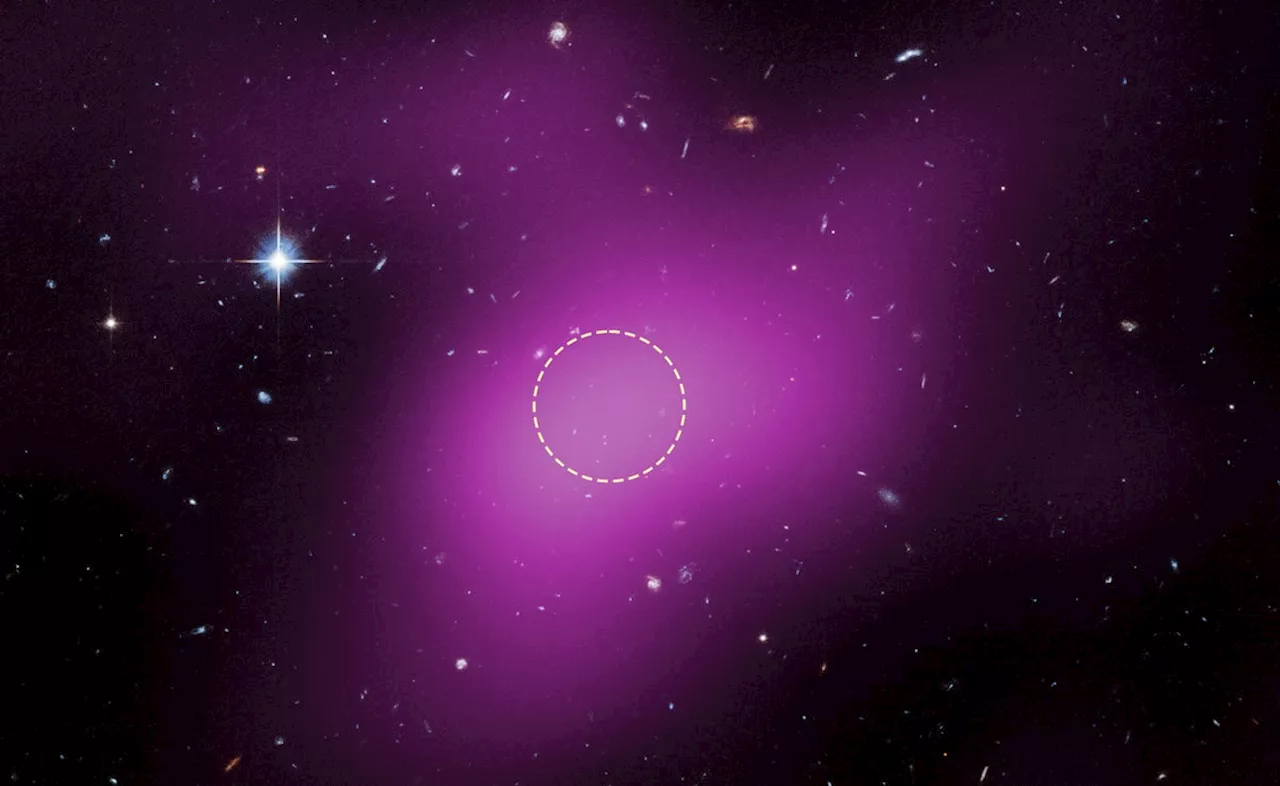
Scientists have announced a groundbreaking discovery: the existence of a new type of astrophysical object, dubbed Cloud-9, which represents the best evidence yet for long-predicted “failed galaxies.” Located approximately 14 million light-years from Earth, this dark matter-rich cloud consists primarily of hydrogen gas and lacks stars, distinguishing it from typical galaxies.
The object, identified through radio data from the ground-based Very Large Array, exhibits diffuse magenta signals indicating the presence of hydrogen gas. Researchers initially speculated that Cloud-9 could be a dwarf galaxy, albeit one without visible stars. Subsequent observations conducted with the Hubble Space Telescope confirmed that there are no stars within this cloud, as the only visible objects appear to be background galaxies.
Understanding Cloud-9’s Unique Composition
Astronomers have classified Cloud-9 as a Reionization-Limited H I Cloud (RELHIC), a term indicating its significant amount of neutral hydrogen. This classification suggests that it is a primordial relic from the universe’s early epochs, which, for reasons yet to be understood, never formed stars or evolved into a full-fledged galaxy. According to Rachael Beaton, an astronomer at the Space Telescope Science Institute, “not every dark matter halo will have a galaxy in it.” This finding supports predictions that such starless objects exist throughout the cosmos.
Cloud-9 first gained attention in 2022 when it was discovered by the Five-Hundred-Meter Aperture Spherical Radio Telescope in Guizhou, China. Researchers found a nearly 5,000-light-year-wide spherical cloud of hydrogen gas, which appeared to resemble a faint dwarf galaxy. Further studies revealed that it contains about one million solar masses of hydrogen and approximately five billion solar masses of dark matter. Despite this mass, researchers were initially unable to confirm the absence of stars, leading to debates about its true nature.
Further Investigations and Implications
In a concerted effort to clarify Cloud-9’s status, Beaton and her colleagues conducted additional observations using the Hubble Space Telescope. Their findings indicated hints of a single star within the cloud, but simulations suggested that no more than 3,000 solar masses worth of stars could exist in Cloud-9. This scarcity of stars effectively rules out the possibility of it being a dwarf galaxy.
The implications of this discovery are significant. It positions Cloud-9 as the foremost example of a RELHIC, advancing our understanding of cosmic formation. As noted by astronomer Kristine Spekkens from Queen’s University in Ontario, while the new information from Hubble “certainly eliminates the possibility that it is a dwarf galaxy,” there remains much to learn about this unusual object. Its shape deviates from expected smoothness, suggesting that more detailed mapping of its gas distribution could yield insights into its formation and evolution.
Despite the challenges in definitively categorizing Cloud-9 as a RELHIC, the discovery opens doors for further research into similar objects. Astronomer Ethan Nadler from the University of California, San Diego, emphasized that finding comparable starless clouds could shed light on this dark area of astronomy. As researchers continue to investigate, Cloud-9 stands as a testament to the complexities of the universe and the mysteries still waiting to be uncovered.

Robinhood Stock Surges 2.5% in Early Trading on March 17

Israel Intensifies Strikes as Global Energy Crisis Looms

CALV Offers Class on Communication Skills for Real Estate Professionals

Historic Bideford Pub Reopens as The Patch Wine Bar & Kitchen

Oscar Night Celebrations: Winners, Guests, and Exclusive After-Parties

Samsung Galaxy Watch 9 Set for Larger Battery Boost, Report Reveals

Kibble vs. Fresh Dog Food: What’s Best for Your Dog’s Health?

Acclaimed San Francisco Pizzeria Del Popolo to Close in May

‘Invincible’ Season 4 Launches on Prime Video with Epic Action

ALMA Discovers Companion Orbiting Giant Red Star π 1 Gruis

Doctoral Candidate Trivanni Yadav Advances Battery Research at UTulsa

Global Air Forces Ranked by Annual Defense Budgets in 2025

Rev. Bry Shields to Retire as McGill-Toolen President in 2026

Mass Production of F-35 Fighter Jet Drives Down Costs

Tucson Celebrates Life and Remembrance at 36th Annual All Souls Procession

Gold Investment Surge: Top Mutual Funds and ETF Alternatives

DirecTV to Launch AI-Driven Ads with User Likenesses in 2026

Paul Giamatti Reveals Villainous Role in Star Trek: Starfleet Academy
-
 Science9 months ago
ALMA Discovers Companion Orbiting Giant Red Star π 1 Gruis
-
 Science8 months ago
Doctoral Candidate Trivanni Yadav Advances Battery Research at UTulsa
-
 World10 months ago
Global Air Forces Ranked by Annual Defense Budgets in 2025
-
 Lifestyle10 months ago
Rev. Bry Shields to Retire as McGill-Toolen President in 2026
-
 World10 months ago
Mass Production of F-35 Fighter Jet Drives Down Costs
-
 Lifestyle9 months ago
Tucson Celebrates Life and Remembrance at 36th Annual All Souls Procession
-
 Business10 months ago
Gold Investment Surge: Top Mutual Funds and ETF Alternatives
-
 Top Stories10 months ago
DirecTV to Launch AI-Driven Ads with User Likenesses in 2026
-
 Entertainment10 months ago
Paul Giamatti Reveals Villainous Role in Star Trek: Starfleet Academy
-

 Lifestyle8 months ago
Maumee’s Shop With a Hero Event Delivers Joy to Local Children
-

 Top Stories10 months ago
New ‘Star Trek: Voyager’ Game Demo Released, Players Test Limits
-

 Lifestyle8 months ago
Cape May Shines as New Jersey’s Only Entry on Beach Town List